

Why Do My Legs Sink When Swimming Freestyle? Causes, Fixes, and Drills
/One of the most common questions I hear from swimmers is, “Why do my legs sink when I swim?” They may have enough fitness to complete the workout and enough strength to pull hard, but freestyle still feels like an uphill battle. Their upper body moves forward while their hips and feet trail lower in the water, creating resistance with every stroke.
After more than 20 years of coaching, I have learned that sinking legs are rarely solved by one universal cue. Some swimmers lift their head. Others lose alignment when they breathe, press down during the catch, or kick from the knees. Natural buoyancy and body composition also matter.
The solution is not to force every swimmer into an identical position. It is to identify what is pulling your hips down and make the smallest correction that creates a longer, more balanced bodyline. Excellence lives in the fundamentals, and body position is one of the most important fundamentals in freestyle.
Why Sinking Legs Slow Down Your Freestyle
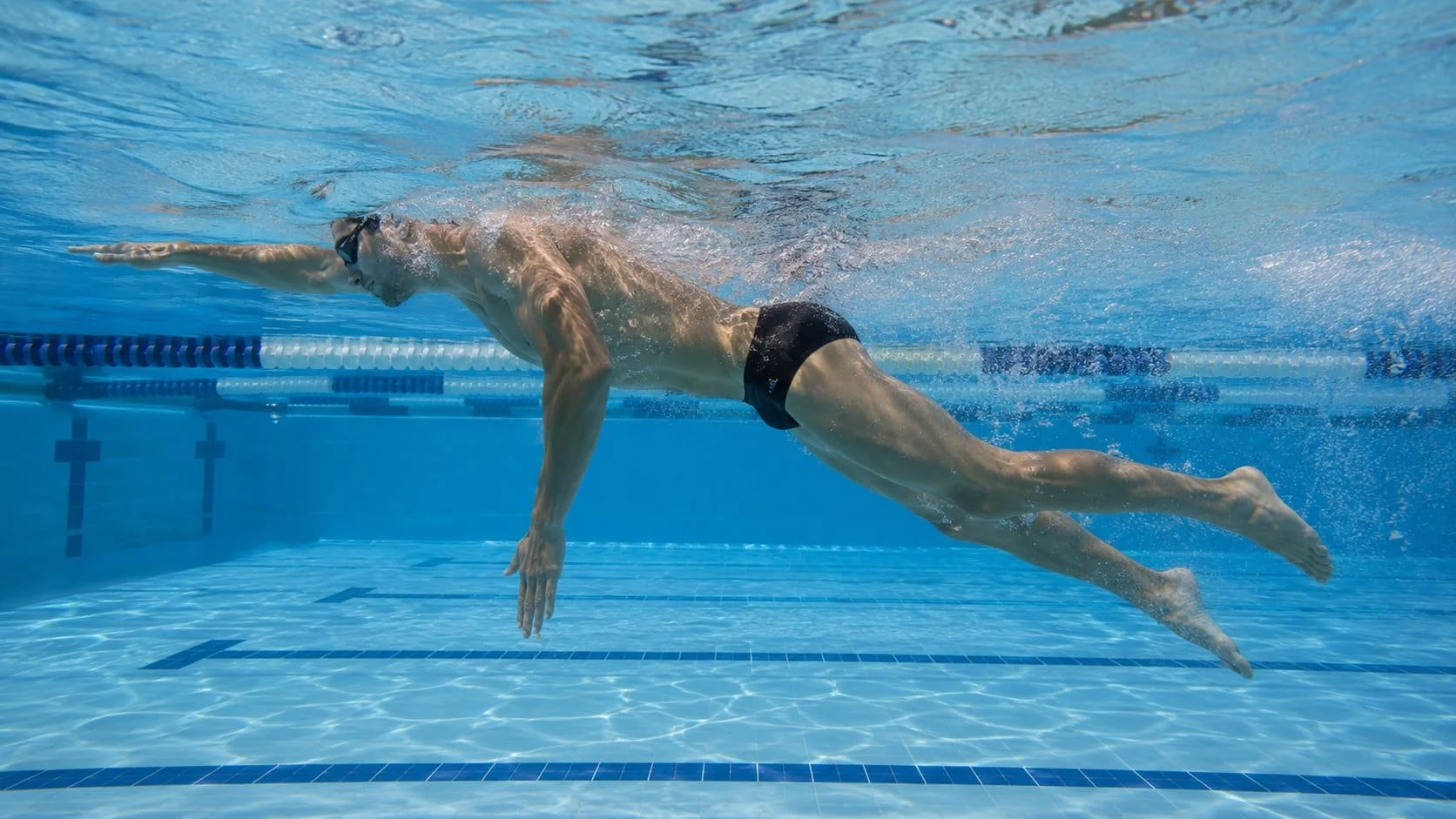
When your hips and legs drop, your body presents a larger surface to the water. Instead of moving forward through a narrow opening, you pull a sloped bodyline behind you. This increases drag and forces the arms and legs to work harder for the same speed.
Swimmers with low hips often notice that freestyle feels harder than their fitness level suggests. They may need an aggressive kick to stay level, become short of breath during easy swimming, or feel much faster with a pull buoy.
A good body position does not require every part of your body to sit above the surface. The goal is to keep your head, shoulders, trunk, hips, and legs organized into the cleanest line your individual buoyancy allows.
Why Do My Legs Sink When Swimming?
Your lungs make the chest relatively buoyant, while gravity acts through the body’s mass. Because those forces do not act at exactly the same point, the lower body naturally tends to drop for many swimmers. Bone density, body composition, lung volume, and where you carry muscle and fat all influence how easily you float.
You cannot change every part of that equation, and you do not need to. Technique determines whether you work with your natural buoyancy or make the imbalance worse. In my experience, sinking hips in freestyle usually come from one or more of these five causes.
1. Your Hands or Head Are Too High
Where your hands and head point, your body tends to follow.
If your hand enters the water too flat or shallow, it can increase drag and negatively affect your body position. Think of the flaps on an airplane wing: when your hand pitches upward, your body can follow, creating an uphill position that increases resistance and slows you down. Conversely, angling your hand slightly downward during the extension can help position your body more horizontally or downhill, reducing drag and improving efficiency.
Your head position has a similar effect. Looking too far forward or lifting the crown of your head can raise your upper body, causing your hips and legs to sink.
Think of your hands and head as a counterbalance to your hips and heels, much like a seesaw. During the forward extension, your hand should reach slightly below your elbow and shoulder, while your head stays low and your chest remains gently pressed into the water. This helps your hips and heels ride closer to the surface, creating a longer, more streamlined body position.
The takeaway: Keep your head low, extend your hand slightly downward, and maintain a balanced body position to minimize drag and swim faster with less effort.
Let the water support your head and keep the neck neutral. Your eyes will generally look toward the bottom or slightly forward, not straight ahead. Generally 0-45 degrees of neck extension is recommended, so experiment until you find the position that keeps your spine long and your hips close to the surface.
Research on passive drag supports the importance of head alignment, showing that a change in head position can materially affect resistance. The practical lesson is simple: the head is the front of your bodyline, not a separate piece.
2. You Lift to Breathe Instead of Rotating
Some swimmers hold a good position until they need air. Lifting the head forward before turning pushes the chest up, drops the hips, and may cause the legs to separate.
Rotate to the breath with the shoulders and hips while keeping the head connected to the spine. Take the breath low and return the face smoothly before the recovering hand enters. If breathing is when your legs sink, review how to breathe while swimming freestyle before adding more kick effort.
3. Your Catch Pushes Water Down
If the lead hand presses toward the bottom, the chest may rise while the hips fall. This creates vertical movement instead of forward propulsion.
That does not mean the hand should remain at the surface. The hand moves below the elbow as the forearm sets into the catch. The difference is where you direct pressure: establish the hand and forearm vertically, like an oar, then send water primarily backward rather than continuing to push down. Imagine you have jets on your hand and forearm. Point them backwards to propel yourself forward. See how to improve your freestyle catch for a complete breakdown.
4. Your Trunk Loses Its Shape
“Use your core” does not mean bracing as hard as possible. Excessive tension can make the stroke rigid and interfere with breathing and rotation. You need enough control to keep the rib cage and pelvis connected while your body rotates.
Think about length from the crown of the head through the toes. Avoid flaring the ribs or exaggerating the lower-back arch. If limited shoulder, thoracic, or hip movement prevents you from holding that line, combine pool work with targeted freestyle mobility training.
5. Your Kick Creates Drag
A weak kick is not automatically the reason your legs sink, but an inefficient kick can make the problem worse. Common errors include excessive knee bend, a kick that travels too deep, legs that separate during breathing, and stiff ankles that increase resistance.
Use a compact flutter kick initiated from the hips, with relaxed knees and ankles. Distance swimmers do not need to sprint-kick through every easy swim, but their kick must still support balance, rotation, and rhythm, with enough force and tempo when it counts for some extra speed.
Is Kicking Harder the Answer?
Kicking harder can lift the legs, which is why it may appear to solve the problem over 25 yards. But if you need a near-sprint kick to hold body position during a 500-yard freestyle, 1,500-meter race, or triathlon swim, you are using valuable energy to compensate for poor alignment. 75% of the muscle in your body is below your waist, and your kick only contributes about 10-20% of propulsion in freestyle. Your legs consume a tremendous amount of energy and oxygen for modest power. Use them strategically for the speed and distance you want to go.
I prefer to reduce avoidable drag first, then use the kick for propulsion, rhythm, and stability. Sprinters may apply much more kick power than distance swimmers, but even they benefit from a bodyline that does not depend entirely on leg effort.
Catch Scull Drill for Better Body Position
Catch Scull connects three skills swimmers often treat separately: head position, pressure at the front of the stroke, and whole-body alignment. It teaches you to hold water without pushing your upper body upward.
Do your hips and feet sink when you swim?
How to Perform Catch Scull
Start face down with both arms extended in front and the neck neutral. A center-mount snorkel and fins can help you focus without interrupting the position to breathe.
Keep the back of the head, upper back, shoulders, and hips close to the surface. Think long through the spine rather than arching the lower back.
Point the fingers down and keep the elbows above the hands. The hand should be deeper than the elbow, and the elbow below the shoulder.
Quickly sweep the hands and forearms out and in with a compact motion. Maintain pressure in both directions rather than letting the hands slip.
Use a light, narrow kick only as needed. Feel the forearms support the front of the stroke while the body stays aligned.
The key cue from the video is, “Wherever it points, your body follows.” Pay particular attention to the head. If it angles forward and up, the hips are likely to drop. Keep the crown reaching forward, the eyes down, and the back of the head aligned with the upper back.
“Fingers down, elbows up” helps establish the front of the catch, while the quick out-and-in sweep teaches continuous pressure. Keep the motion compact. For additional variations, use the full guide to sculling swimming drills.
Three More Drills to Stop Your Legs from Sinking
Choose the drill that addresses where your alignment breaks down, then transfer the corrected position into full freestyle.
1. Surface Kick With Fins and Snorkel
Use a center-mount snorkel and fins to practice a long, level body position without the disruption of breathing. Keep your eyes directed downward, relax the neck, and allow the head to remain neutral. Kick from the hips with a compact motion and keep the feet close to the surface.
The fins provide enough speed to help you feel a higher body position, but avoid relying on them to force your legs upward. The goal is to recognize the alignment you want to maintain after the fins come off.
2. Side Kick With One Arm Extended
Kick on your side with the lower arm extended and the upper arm resting against the thigh. Keep the head aligned with the spine and rotate only enough for the mouth to clear the water.
This drill can reveal whether you lift your head, press the lead arm downward, or allow the legs to separate when breathing. Use fins initially if swimming at a low speed makes it difficult to maintain alignment.
3. Freestyle With Fins and Snorkel
Now transfer the improved body position into complete freestyle. A center-mount snorkel removes the breathing turn, while the fins help you maintain rhythm and forward momentum.
Swim relaxed 25s while keeping the eyes down, the neck neutral, and the kick compact. Direct pressure from the catch backward instead of pressing down on the water. Gradually reduce how much support you take from the fins, then repeat the same distance without equipment.
What matters is not simply swimming higher while wearing fins. You should be able to preserve the same head position, balance, and bodyline when you return to regular freestyle.
An 800-Yard Body-Position Set
Use this set early in practice while you are fresh enough to notice small changes:
200 easy freestyle: Notice when the hips feel highest and when they drop.
4 x 25 front balance into freestyle: Float for 5 seconds, then swim easy. Rest 15 seconds.
4 x 25 Catch Scull: Use a snorkel and optional fins. Rest 15 seconds.
4 x 50 as 25 drill/25 swim: Alternate Catch Scull and side kick by 50. Rest 20 seconds.
4 x 50 freestyle build: Increase speed without lifting the head or making the kick deeper. Rest 20 seconds.
Do not judge the set only by whether your feet touch the surface. Ask whether the stroke feels lighter, pace improves at the same effort, or stroke count drops without an artificial glide. Those changes show that the work is transferring.
How to Identify the Real Cause
Swimmers are not always reliable judges of their own alignment. A head position that feels neutral may be lifted, and a compact-feeling kick may separate during every breath.
Film from the side both above and below the surface if possible. Record normal freestyle, easy no-breath swimming, and several breathing cycles. Comparing the clips can reveal whether the problem is constant or linked to one specific action.
Train Daly’s swimming video technique analysis uses underwater review, individualized feedback, and drills selected for your mechanics rather than a generic correction.
Frequently Asked Questions
Why do my legs sink even when I am relaxed?
Natural buoyancy varies. Air in the lungs makes the chest relatively buoyant, while the lower body may be denser. Some leg drop during a passive float is normal. The goal is to avoid technical habits that make your natural position worse.
How do I keep my hips up when swimming freestyle?
Keep the neck neutral, rotate rather than lift to breathe, maintain a connected trunk, direct catch pressure backward, and use a compact kick from the hips. Test one change at a time so you can identify what improves your position.
Will a pull buoy fix sinking legs?
A pull buoy raises the hips and demonstrates a more horizontal position, but it does not correct the cause by itself. Use it for contrast: swim a short repetition with the buoy, remove it, and recreate the alignment through your own mechanics.
Do fins help with sinking legs?
Fins add propulsion and help keep the legs near the surface while learning a drill. Gradually remove them so the correction transfers to normal swimming.
Final Thoughts
If your legs sink when swimming freestyle, do not assume you are simply a poor floater or need to kick harder. Start at the front of the bodyline. Check where the head points, what happens during the breath, and whether the catch sends pressure down or back. Then look at trunk control, mobility, and kick mechanics.
Make one correction, test it over short repeats, and measure what changes. Better body position should reduce effort or improve speed without demanding constant tension. That is the standard I use with swimmers: not whether a drill looks perfect in isolation, but whether it helps you swim more efficiently in full stroke.
Not Sure Why Your Legs Keep Sinking?
Small changes in head position, breathing, catch mechanics, or kick timing can completely change your bodyline. A personalized video technique analysis can identify where the problem begins and give you specific corrections to practice.
Dan Daly, CSCS, is a swim coach and former collegiate swimmer with more than 20 years of coaching experience. Through Train Daly, he works with competitive, Masters, open water, and triathlon swimmers using an integrated approach to technique, strength, recovery, and performance.
References