

The 80/20 Rule in Freestyle Swimming: A 60-Minute Workout
/One of the most common problems I see among competitive swimmers is that every freestyle practice gradually settles into the same moderately hard effort. Easy repetitions become faster than intended, while race-pace repetitions are not fast enough to develop meaningful speed. The swimmer finishes tired, but the purpose of the workout becomes unclear.
The 80/20 rule creates a clearer separation between training intensities. Approximately 80% of the work is completed at an aerobic, controlled, low intensity, while the remaining 20% is dedicated to demanding, high-quality efforts.
Research involving elite junior swimmers suggests that a polarized training distribution can support performance while producing less perceived fatigue than a threshold-heavy approach. However, every swimmer does not need the same intensity distribution. Sprinters, middle-distance swimmers, and distance athletes require different combinations of aerobic, threshold, and high-intensity training. That is why I treat the 80/20 rule as a practical starting framework rather than a fixed formula.
For freestyle swimmers, this separation is especially valuable. Controlled aerobic swimming creates an opportunity to reinforce body position, stroke timing, the catch, breathing, turns, and distance per stroke. The faster work then teaches you to preserve those mechanics as speed and fatigue increase.
In this article, I’ll explain how the 80/20 rule applies to freestyle training and provide a complete 60-minute workout built around 200-yard freestyle race pace.
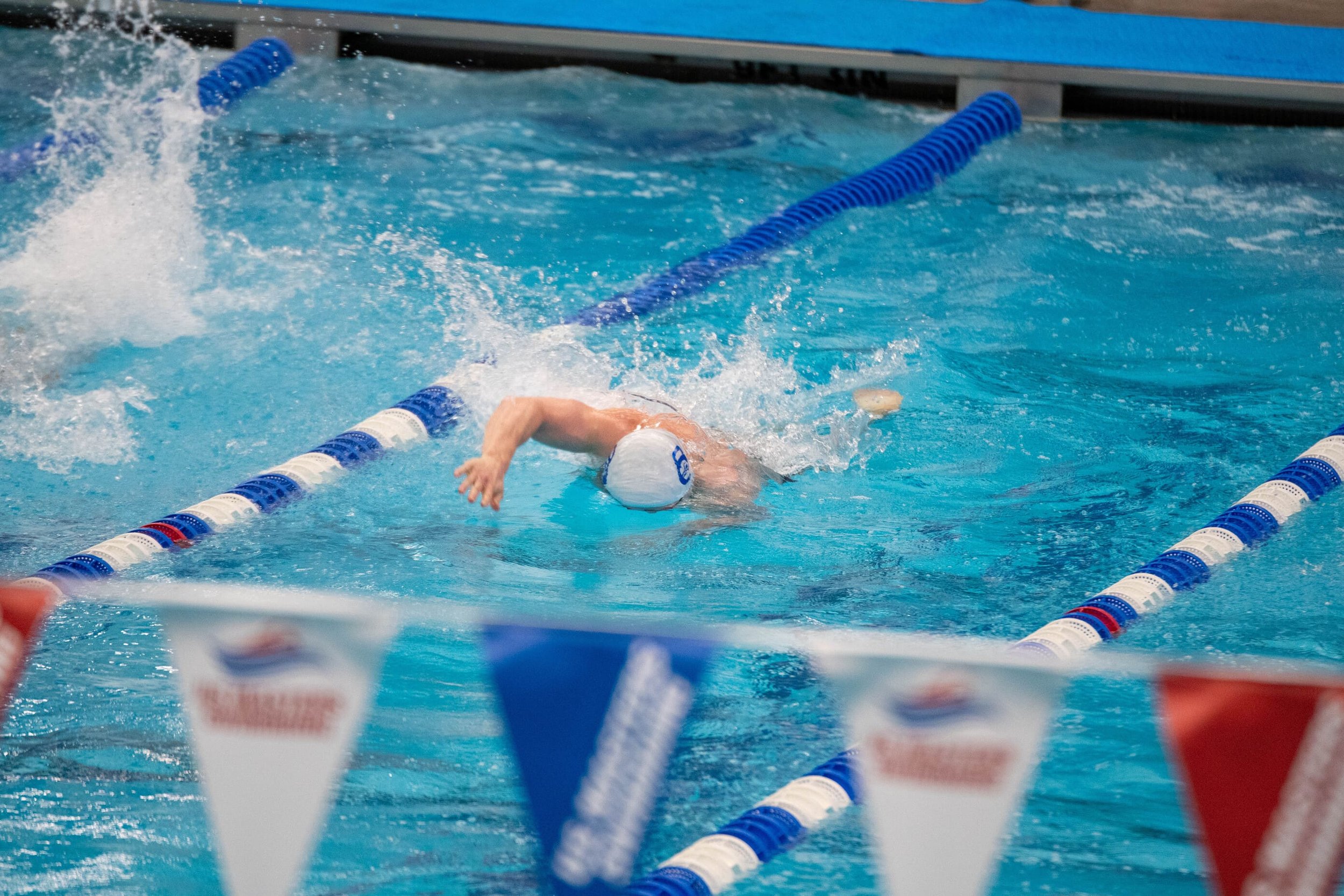
What Is the 80/20 Rule in Swimming?
The 80/20 rule is a simple way to organize training intensity:
Approximately 80% at a low, controlled intensity
Approximately 20% at a high intensity
Limited unplanned training in the moderate zone between them
The method is often associated with polarized endurance training, in which most training is relatively easy and a smaller portion is deliberately hard. However, 80/20 should be treated as a practical framework rather than a rigid formula.
In freestyle swimming, low-intensity work may include:
aerobic freestyle volume
Recovery swimming
Freestyle drills
Controlled kicking and pulling
Technical work on turns and underwater transitions
High-intensity work may include:
25, 50-, 100m repeats at race or anerobic intensities
VO2 max sets
Sprint repetitions
Fast kicking
High-quality resisted or assisted swimming
The distribution can be measured by distance, time, or complete training sessions. Because swim practices frequently include several intensities, tracking the distance completed in each zone is often the most practical option.
Why Use the 80/20 Rule for Freestyle?
Freestyle speed depends on more than effort. Swimmers must maintain an efficient body line, connect the catch to the rotation, control their breathing, and apply pressure to the water without creating unnecessary drag.
When swimmers perform too much work at a moderately hard pace, technique often begins to deteriorate. They may shorten the front of the stroke, cross over during the entry, rush the catch, lift the head to breathe, or lose speed through the turns.
Controlled aerobic swimming creates an opportunity to improve fitness while practicing efficient movement. It also helps swimmers accumulate training volume without carrying excessive fatigue into their most important race-pace sets.
The high-intensity 20% has a different purpose. This is where swimmers learn to produce speed, maintain stroke rate, execute fast turns, and hold their mechanics under race-specific pressure.
The objective is not to avoid hard training. It is to arrive at the hard work prepared to do it well.
Understanding Freestyle Training Intensity
Before following an 80/20 program, swimmers need to recognize the difference between low, moderate, and high intensity.
Hello, World!
RPE means rating of perceived exertion on a scale from 1 to 10.
During low-intensity freestyle, you should feel controlled rather than strained. Your pace should be repeatable, and your stroke count should remain relatively stable.
During high-intensity repetitions, speed must be meaningful. If you are assigned 200-yard freestyle pace but lose several seconds by the final repetition, the target may be too aggressive, the rest may be insufficient, or your technique may be breaking down.
Easy Freestyle Should Still Be Technical
“Easy” describes the intensity, not the quality of the swimming.
I often remind swimmers that excellence lives in the fundamentals. Your easy yardage is where you repeat those fundamentals hundreds of times.
During low-intensity freestyle, focus on:
Maintaining a long, balanced body position
Keeping the head stable during the breath
Entering the water in line with the shoulder
Setting the catch before increasing pressure
Connecting the catch to body rotation
Holding a consistent stroke count
Carrying speed through turns and breakouts
Easy swimming should feel smooth, but it should never become careless. If your hips begin to drop or your entry starts crossing the centerline, reduce the pace and restore the movement pattern.
This technical discipline is one of the greatest advantages of properly controlled aerobic training.
How to swim better freestyle
Expand Your Range of Freestyle Speeds
Zones, target paces, perceived exertion, and tempo are all useful ways to define training intensity. However, I have found that different cues resonate with different swimmers. One athlete may respond well to specific split times, while another understands intensity more clearly through stroke rate, effort, or breathing control.
This is especially important for adult and masters swimmers. Many develop a narrow range of available speeds over time. Their easy pace, moderate pace, and hard pace begin to look surprisingly similar.
How to train different zones for swimmers
Speed and power can decline with age, particularly when swimmers stop training them directly. However, that decline does not have to be as significant as we often see. One reason this happens is that swimmers gradually begin focusing almost exclusively on longer, relatively low-intensity distances. Aerobic work remains valuable, but your sustainable pace may eventually become limited if you stop training goal pace, stroke tempo, and power.
If you always swim at the same comfortable speed, how will your body learn to respond when you ask it to move faster?
This does not mean every workout should become a sprint session. It means speed and pace work should remain part of the overall program. Short, high-quality freestyle repetitions can help you maintain:
Neuromuscular coordination
Faster turns and breakouts
The ability to change pace during a race
Efficient technique at higher speeds
The longer aerobic repetitions also provide an opportunity to incorporate controlled pace changes. For example, you might swim the first 75 yards of a 100 at an easy aerobic effort and increase to goal pace for the final 25. Another option is to include several race-pace 50s between longer controlled swims, as you will do in the workout below.
This is one of the practical benefits of the 80/20 approach. Most of your freestyle volume remains controlled and technically focused, but a smaller portion requires you to leave your comfort zone and access a genuinely different speed.
The goal is not simply to swim harder. It is to preserve your ability to produce speed and then bring that speed back into your longer efforts.
60-Minute 80/20 Freestyle Workout
This 3,000-yard freestyle workout is designed for competitive swimmers familiar with interval training.
The workout uses the 200-yard freestyle as its primary race focus. It contains 2,400 yards of low-intensity swimming and 600 yards of high-intensity work, creating an 80/20 distribution by yardage. This is a practical pool-based calculation rather than a precise measurement of time spent in each physiological zone.
Workout Overview
Duration: Approximately 60 minutes
Total distance: 3,000 yards
Low-intensity distance: 2,400 yards
High-intensity distance: 600 yards
Primary stroke: Freestyle
Race focus: 200-yard freestyle
Equipment: Optional snorkel and fins
Warm-Up – 600 Yards Easy
300 easy freestyle
4 × 50 freestyle drill/swim by 25, resting 10 seconds
4 × 25 freestyle build to approximately 70% effort, resting 10 seconds
For the drill 50s, alternate between:
6-kick switch to work on body position and rotation
Front scull into freestyle to establish an effective catch
The 25-yard builds should gradually increase speed without becoming high-intensity efforts. Keep the stroke long and controlled.
Freestyle Technique and Aerobic Preparation – 400 Yards Easy
Complete:
8 × 50 freestyle at RPE 3–4
Rest 10–15 seconds after each repetition
Alternate the focus:
Odd 50s: Distance per stroke and patient catch
Even 50s: Fast streamline, breakout, and turn
Count your strokes during the first and final 50. The goal is to maintain a similar count without forcing an unnaturally long stroke.
Main Set – 1,800 Yards
Complete three rounds:
4 × 100 freestyle at RPE 3–4
Rest 10–15 seconds after each 100
4 × 50 freestyle at approximately 200-yard race pace
Rest 30–45 seconds after each 50
Each round contains:
400 yards of low-intensity freestyle
200 yards of high-intensity freestyle
Take an additional 30 seconds between rounds if needed.
During the easy 100s, focus on relaxed breathing, a stable head position, and consistent pressure through the catch. Do not allow these repetitions to drift into threshold pace.
During the fast 50s, focus on:
Accelerating into the first breakout
Establishing race stroke rate quickly
Maintaining pressure through the catch
Keeping the breath connected to the rotation
Attacking the turn without shortening the final stroke
Holding speed through the finish
If your pace drops significantly, add recovery before continuing. Completing more slow repetitions does not improve the quality of a race-pace set.
Cooldown – 200 Yards Easy
200 easy freestyle
Gradually lower your stroke rate and allow your breathing to settle. Maintain a long body line without exaggerating the glide.
Workout Intensity Breakdown
Hello, World!
How to Calculate Your 200 Freestyle Training Pace
Start with a recent 200-yard freestyle time or a realistic goal time and divide it by four.
For example, if your current 200 freestyle time is 1:52:
1:52 equals 112 seconds
112 ÷ 4 = 28 seconds
Your average race pace is approximately 28 seconds per 50
Because the race time includes a starting dive while these repetitions begin from a push, your training target may need to be slightly adjusted. If split data is available, the average of your second, third, and fourth 50s can provide a more realistic starting point.
Modifying the Workout for Other Freestyle Events
The structure can also be adapted for 100- or 500-yard freestyle swimmers.
For 100-Yard Freestyle Swimmers
Complete the fast repetitions at approximately 100-yard race pace, but increase the recovery to 45–60 seconds.
Because the target speed is higher, protecting stroke rate and technical quality is more important than strictly maintaining the original send-off.
For 500-Yard Freestyle Swimmers
Complete the fast 50s at approximately 500-yard race pace with 15–25 seconds of rest.
The repetitions should still feel purposeful, but the emphasis shifts toward pace control, efficient turns, and consistent stroke mechanics.
For More Advanced 200 Freestyle Swimmers
Alternate the fast 50s within each round:
First 50 at the opening speed of the race
Second and third 50s at controlled middle-race pace
Fourth 50 at closing speed
This allows swimmers to practice the changing demands of the 200 freestyle rather than treating every repetition identically.
Using 80/20 Across a Training Week
This workout demonstrates the 80/20 concept within one practice, but the method is more useful when evaluated across an entire week or training block.
Not every practice needs an exact 80/20 split. One session may be almost entirely easy and technical, while another may contain a higher percentage of race-pace work.
The balance should also change throughout the season. As an important competition approaches, swimmers can reduce overall volume while preserving selected race-pace efforts. Learn more about how to structure a taper in swimming to reduce fatigue and peak at the right time.
For example, a freestyle swimmer completing 20,000 yards per week might accumulate approximately:
16,000 yards of aerobic, technical, and recovery swimming
4,000 yards of race-pace, VO2 max, and sprint work
Moderate or threshold training can still be included when it supports the swimmer’s event. The goal is to prevent moderately hard swimming from dominating the program without a clear reason.
I also recommend tracking more than distance. Consider recording:
Target and actual pace
RPE
Stroke count
Stroke rate
Breathing pattern
Turn quality
Ability to recover before the next practice
Two swimmers can complete the same 3,000-yard workout and experience very different training loads.
Common 80/20 Freestyle Training Mistakes
Swimming the Easy Repetitions Too Fast
If the easy 100s become competitive, the swimmer creates unnecessary fatigue before the race-pace work. Stay disciplined enough to let easy swimming remain easy.
Treating Easy Swimming as Recovery Only
Low-intensity freestyle is also technical practice. Use it to reinforce your body line, catch, breathing, turns, and distance per stroke.
Missing Race Pace on the Fast 50s
If the repetitions are several seconds slower than your target, the set is no longer producing the intended stimulus. Adjust the target, increase the rest, or stop the set when technique deteriorates.
Following the Percentage Too Rigidly
An 80/20 distribution is a framework, not a law. Sprint and distance freestyle swimmers require different combinations of aerobic, threshold, speed, and race-specific training.
Trying to Change the Entire Program Immediately
Do not suddenly add large amounts of high-intensity swimming simply to reach 20%. Training volume and intensity must progress gradually and fit the swimmer’s experience, event schedule, and recovery capacity.
Is 80/20 Training Right for Every Freestyle Swimmer?
The 80/20 approach can be particularly useful for swimmers who regularly go too fast during easy sets but struggle to reach race speed during high-quality work.
However, the precise distribution should always be individualized. A 50-yard freestyle specialist should not follow the same training plan as a 1,650-yard swimmer. Age, experience, training history, season phase, and recovery capacity also affect the appropriate balance.
Instead of chasing a perfect percentage, ask:
Is my easy freestyle controlled enough?
Can I maintain efficient mechanics throughout the aerobic work?
Is my high-intensity swimming truly fast?
Can I hold the assigned race pace?
Am I recovering between key practices?
Is my training improving my race performance?
The answers are more important than whether every week finishes at exactly 80%.
Final Thoughts
The greatest value of the 80/20 rule is not the percentage itself. It is the discipline to give every part of freestyle training a specific purpose.
Controlled aerobic swimming allows you to improve fitness while reinforcing body position, catch mechanics, breathing, turns, and overall efficiency. High-intensity swimming teaches you to preserve those skills at race pace.
Control the easy work, execute the fast work with purpose, and avoid spending every practice at the same moderately hard intensity.
Excellence lives in the fundamentals. In freestyle training, one of those fundamentals is knowing when to control your speed and when to use it.
Want to build a freestyle program around your stroke, race pace, and performance goals? Explore personalized swim coaching with Train Daly.
Dan Daly is a swim coach and Certified Strength and Conditioning Specialist with more than 20 years of coaching experience. Through Train Daly, he helps competitive, collegiate, masters, and open water swimmers improve their performance through individualized swim coaching, technical analysis, and strength programming.