

How to Combine Swimming and Strength Training Without Overtraining
/When swimmers ask me whether they should lift weights and swim, my answer is usually yes. The more important question is how those sessions fit together.
I often see athletes build a swimming and weight training schedule as if the pool and gym were two separate programs. They keep every swim, add two or three lifting sessions, and assume their bodies will adapt. Each workout may look reasonable by itself, but the combined weekly load can quickly become too much.
Most swimmers can combine swimming with two or three weekly strength sessions. The correct schedule depends on your main goal, pool volume, training experience, competition calendar, and ability to recover. The objective is not to fit in as much work as possible. It is to organize the work so that your most important sessions stay productive.
Can You Combine Swimming and Weight Training?
Swimming and weight training can complement each other when they are planned as parts of one program. Swimming develops technique, conditioning, pacing, and specific skill in the water. Strength training builds the physical capacity to produce and control force.
Research generally supports combining strength work with swim training, but the transfer is not automatic. Becoming stronger in the gym only helps when you can apply that capacity effectively in the water.
Your combined program should account for:
The number and intensity of your swim practices
The frequency and volume of your strength sessions
Your primary events and performance goals
Your experience with resistance training
Your work, school, travel, and family schedule
Sleep, nutrition, stress, and injury history
This is why I do not begin with a universal weekly template. I begin with the swimmer. Excellence lives in the fundamentals, and recovery is one of those fundamentals.
If you are deciding how frequently to train in the gym, read How Often Should Swimmers Lift Weights?.
Swimming and Weight Training Benefits
The pool develops swimming skill, but water does not provide enough resistance to maximize strength and power. A well-designed dryland program can fill that gap.
Greater Strength and Power
Strength training can support stronger starts, turns, push-offs, underwaters, and sprinting. It can also help you preserve force production as fatigue develops.
That does not mean every swimmer needs a bodybuilding routine or maximal lifting. The exercises, loads, and training volume should reflect the swimmer’s age, experience, event, and phase of the season.
Better Force Transfer
Swimming requires the body to connect the catch, trunk, hips, and kick. Strength training can improve the ability to stabilize the body and transfer force rather than allowing energy to leak through poor positions.
Improved General Physical Capacity
Swimmers repeat thousands of similar movements. General physical preparation exposes the body to broader movement patterns, including squatting, hinging, pushing, pulling, carrying, rotating, and resisting rotation.
Support for Long-Term Training
A thoughtful program can address strength limitations, movement control, and workload tolerance. Strength training cannot guarantee that an injury will never occur, but it can form part of a more complete approach to durable performance.
Start With Your Primary Goal
Before choosing between swimming and weight training on the same day or alternate days, decide which result matters most.
| Primary goal | Main priority | Typical strength frequency | Scheduling focus |
|---|---|---|---|
| Competitive swimming | Pool performance | 2–3 sessions | Protect technique, speed, and race-pace practices |
| Sprint performance | Strength and power | 2–3 sessions | Coordinate lifting with high-speed work |
| Distance or open water | Endurance and durability | 2 sessions | Protect long swims and key aerobic sessions |
| General fitness | Balanced development | 2–3 sessions | Build a schedule you can maintain |
| Weight loss | Consistency and recovery | 2–3 sessions | Avoid excessive volume and underfueling |
If swimming performance is your main goal, the schedule should protect your most important pool sessions. If strength is the priority, you may need to reduce some swim intensity so that your gym work remains progressive.
Trying to make every quality a top priority at the same time usually produces a lot of fatigue and very little clarity.
Swimming and Weight Training on the Same Day
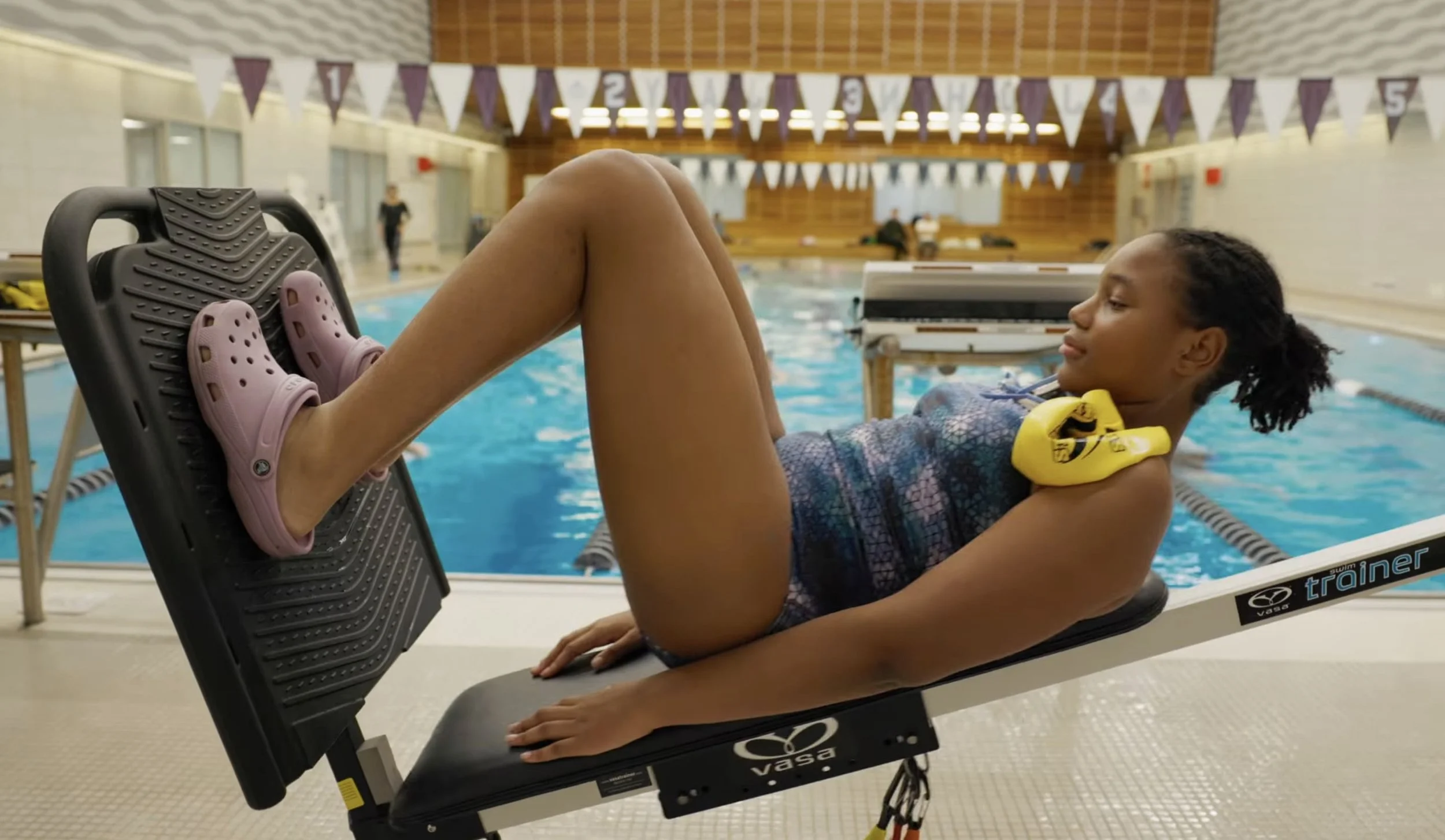
Swimming and weight training on the same day can work well. It can also create space for true recovery days instead of spreading hard training across the entire week.
The key is to decide which session deserves your best energy.
Should You Swim or Lift First?
Swim first when swimming quality is the priority. This is usually the right choice before technical work, race-pace training, sprint sets, or an important team practice. Heavy lifting beforehand may reduce power, coordination, or the ability to hold technique.
Lift first when strength development is the priority. If the main goal is improving force production or progressing a key lift, complete the strength session while you are fresh. The swim that follows should usually be easier or technically controlled.
When both sessions need to be high quality, separate them when your schedule allows. More time between sessions gives you an opportunity to eat, hydrate, and recover mentally before training again.
The order should follow the goal, not a rigid rule.
Same-Day Combinations That Often Work
Technique-focused swim followed by full-body strength
Aerobic swim paired with moderate strength training
Sprint swimming paired with low-volume power training
Heavy strength session followed by an easy recovery swim
Morning swim with an afternoon or evening gym session
Combinations That Need More Caution
Heavy upper-body lifting before important stroke work
High-volume pulling and paddles combined with demanding upper-body lifting
Hard kick sets paired with a high-volume lower-body gym session
Maximal swimming and maximal lifting in the same training block
Two long sessions performed when sleep and nutrition are already poor
The issue is not simply doing two sessions. It is combining sessions that compete for the same physical resources without adjusting volume or recovery.
Swimming and Weight Training on Alternate Days
Swimming and weight training on alternate days is often easier for newer lifters, recreational swimmers, and athletes whose schedules allow only one session per day.
This approach can provide:
More energy for each workout
A simpler routine
More time between training the same muscle groups
A clear mental separation between pool and gym goals
However, alternate-day training is not automatically easier. If you swim hard on Monday, lift hard on Tuesday, swim hard on Wednesday, and continue that pattern all week, you may never have a true low-stress day.
Sometimes it is better to consolidate two compatible sessions on one day and make the following day easier.
| Schedule | Best suited to | Main consideration |
|---|---|---|
| Same-day sessions | Busy and competitive swimmers | Control total daily intensity |
| Alternate days | General fitness and newer lifters | Preserve at least one recovery day |
| Mixed schedule | Most experienced swimmers | Match the plan to key sessions and goals |
Sample Swimming and Weight Training Schedules
These schedules are starting points, not prescriptions. Adjust the volume, intensity, and recovery to your ability and goals.
Two Swims and Two Strength Sessions
This schedule can work for general fitness, weight loss, or returning swimmers.
| Day | Training focus |
|---|---|
| Monday | Full-body strength |
| Tuesday | Technique and aerobic swim |
| Wednesday | Recovery or easy mobility |
| Thursday | Full-body strength |
| Friday | Recovery |
| Saturday | Endurance swim or controlled intervals |
| Sunday | Recovery |
With only four main sessions, each workout can have a clear purpose. Avoid making both swims maximal simply because there are fewer of them.
Three Swims and Two Strength Sessions
This is a practical swimming and gym workout plan for many masters swimmers and recreational competitors.
Placing the first gym session after a technique-oriented swim allows Tuesday to become a lower-stress day. The second strength session should be adjusted so that it does not reduce the quality of Saturday’s priority swim.
| Day | Training focus |
|---|---|
| Monday | Technique swim + full-body strength |
| Tuesday | Recovery |
| Wednesday | Aerobic or threshold swim |
| Thursday | Full-body strength |
| Friday | Recovery or mobility |
| Saturday | Speed, race-pace, or endurance swim |
| Sunday | Recovery |
Four Swims and Two Strength Sessions
This format may suit experienced competitive swimmers.
The exact swim content matters. Four easy practices and four demanding practices are not the same workload. Before adding strength sessions, identify which swims are technical, aerobic, sprint-based, race-paced, or recovery-oriented.
| Day | Training focus |
|---|---|
| Monday | Swim + strength |
| Tuesday | Swim |
| Wednesday | Recovery or mobility |
| Thursday | Swim + strength |
| Friday | Easy swim or technique |
| Saturday | Recovery or competition-specific work |
| Sunday | Recovery |
How Hard Should Strength Training Be?
Swimmers do not need to leave every gym session exhausted. Soreness is not the goal, and fatigue is not proof that a program is effective.
Productive strength training usually includes:
Clear exercise selection
Consistent technique
Progressive resistance
Appropriate sets and repetitions
Enough rest to maintain movement quality
A workload that supports the next important swim
Training to failure on every set can add fatigue without improving transfer to the pool. I prefer repeatable, high-quality work that can progress across weeks and months.
Your gym program should also remain simple enough to evaluate. If the exercises, loads, repetitions, and training methods change constantly, it becomes difficult to know what is actually working.
For exercise selection and a complete routine, see Strength Training for Swimmers: Best Gym Workout.

Strength Training for Swimmers at Home
You can build useful strength at home, especially if you are new to resistance training or have access to bands, dumbbells, kettlebells, or suspension straps.
A home program may include:
Push-up variations
Split squats and reverse lunges
Hip hinges or Romanian deadlifts
Rows using resistance bands or suspension straps
Loaded carries
Anti-extension and anti-rotation core exercises
Jumps or medicine-ball exercises when appropriate
Shoulder and thoracic mobility work
The same programming principles still apply. You need an appropriate challenge and a way to progress it. That progression might come from additional resistance, better range of motion, more control, a harder variation, or carefully increased volume.
Repeating the same easy circuit indefinitely may improve general activity, but it will eventually stop producing meaningful strength adaptations.
Swimming and Weight Training for Weight Loss
Combining swimming and weight training can support weight loss and body-composition goals. Swimming increases energy expenditure and develops cardiovascular fitness, while resistance training helps maintain or build lean mass.
But adding more workouts does not automatically produce better results.
Fat loss still depends largely on maintaining an appropriate energy balance over time. Excessive training can increase fatigue, hunger, and the likelihood of missing sessions. Aggressive dieting can also reduce performance and recovery and make both swimming and lifting feel worse.
If weight loss is the main goal:
Begin with a schedule you can maintain
Keep two or three strength sessions per week
Use a mix of easier and harder swims
Include at least one lower-stress day
Eat enough protein and carbohydrates to support training
Adjust food intake gradually rather than using extreme restriction
For competitive swimmers, especially young athletes, performance and adequate fueling should remain the priority. Body-composition changes should never come at the cost of health, recovery, or a safe relationship with food.
Signs Your Combined Schedule May Be Too Demanding
True overtraining syndrome is more specific and less common than the term “overtraining” suggests. Most swimmers who feel overtrained are dealing with accumulated fatigue, poor recovery, or a schedule that is temporarily too demanding.
Watch for patterns such as:
Normal training pace feels unusually difficult
Performance declines across several sessions
Stroke technique breaks down earlier than usual
Soreness persists and does not improve with easier training
Motivation, mood, or concentration declines
Sleep quality worsens
Increased illness frequency
Gym loads repeatedly decrease without a planned reason
Minor aches become more frequent or persistent
One difficult workout does not mean the program has failed. Look at the pattern across several days or weeks.
Reduce training load when needed instead of trying to force progress through persistent fatigue. Ongoing pain, illness, or unexplained performance changes should be assessed by an appropriate healthcare professional.
Adjust Your Schedule Across the Swim Season
A swimming and weight training schedule should change as the season changes.
Off-Season
The off-season provides more room to build general strength, develop lifting technique, and address physical limitations. Gym volume may be slightly higher because race-specific pool demands are lower.
Early and Mid-Season
Continue developing strength while coordinating gym work with increasing swim volume. The goal is progression without allowing soreness to interfere with important practices.
Competition Phase
As race demands increase, reduce unnecessary gym volume, but maintain intensity by keeping useful strength and power.
Taper
During taper, remove fatigue while maintaining familiarity with key movements. Avoid new exercises, unusually high volume, and workouts that create lasting soreness.
Recovery Between Pool and Gym Sessions
Recovery is part of the program, not something you add only after you become exhausted.
Prioritize:
Consistent sleep
Carbohydrates around demanding sessions
Protein distributed throughout the day
Hydration before and after training
Planned easy days
Periodic reductions in training volume
Adjustments during illness, travel, or unusually stressful weeks
If you complete swimming and weight training on the same day, eat and rehydrate between sessions. The longer or more intense the first workout, the more important that recovery window becomes.
Learn more in Post-Workout Nutrition.
Frequently Asked Questions
-
Two or three strength sessions per week work well for many swimmers. The correct frequency depends on age, experience, pool workload, goals, and recovery. During demanding competition phases, two shorter sessions may be more appropriate than three high-volume workouts.
-
Yes. Same-day training can work well when the session order reflects your main priority and total intensity is controlled. Avoid treating both sessions as maximal efforts every time.
-
Alternate days can work well for general fitness and newer lifters. However, make sure the schedule still contains true recovery days instead of creating a hard workout every day of the week.
-
Swim first when technique, race pace, or pool performance is the priority. Lift first when developing strength is the main goal. If both sessions need to be high quality, separate them when possible.
-
Poorly planned strength training can create fatigue, soreness, or movement restrictions that temporarily reduce swim quality. Appropriate programming should complement swimming rather than compete with it.
-
Yes. Home training can be effective when the exercises provide an appropriate challenge and the program includes a clear method of progression.
-
Yes. The combination can support energy expenditure, cardiovascular fitness, and lean mass. Results still depend on nutrition, consistency, sleep, and a training load you can recover from.
Build a Program Around Your Swimming
A good swimming and weight training schedule is not created by adding more workouts. It is built by deciding which sessions matter most and organizing the remaining work around them.
That balance will look different for a high school sprinter, a masters swimmer, an open-water athlete, and someone training for general fitness. Your program should reflect your goals, available equipment, training history, weekly schedule, and ability to recover.
Train Daly Custom Programs combine swimming, strength and conditioning, recovery, and progression into one coordinated plan. Instead of guessing where to place each workout, you receive a schedule built around your performance goals and real life.
Get a personalized swimming and strength program designed for you.