

Strength Training for Swimmers: The Best Gym Workout to Improve Performance
/Most swimmers spend hours in the pool—but never see the strength gains they expect. I’ve seen this pattern for years. You train consistently, your yardage is there, but when the race tightens up, the power just isn’t. Your stroke starts to slip, your catch loses pressure, and suddenly you’re working harder for less speed.
That’s where strength training for swimmers actually earns its place.
Done right, the gym doesn’t compete with your swimming—it supports it. It builds the strength behind your stroke so you can apply force more effectively, hold technique under fatigue, and stay durable through long seasons.

6 Phases of Freestyle
Download the free 6 Phases of Freestyle guide and start refining your technique today. Get the Free Guide →
Why Strength Training Matters for Swimmers
The most specific way to improve in swimming is still swimming. That’s always going to be true.
But here’s what I remind my athletes: you can’t express strength in the water that you don’t have on land.
In the gym, we’re not trying to recreate the stroke. We’re building the engine behind it. That means developing stronger hips for starts and turns, more stable shoulders for consistent pulling, and a core that actually connects your upper and lower body instead of leaking energy every stroke.
A well-structured gym workout for swimmers fills the gaps that pool training alone can’t address.
Best Compound Exercises for Swimmers
Gym Body vs. Swimmer’s Body: What’s the Difference?
This conversation comes up more often than you’d think.
On the surface, it looks like a question about appearance—but in reality, it’s about performance.
A traditional “gym body” is often built around size and isolated strength. You’ll see well-developed muscles, but not always the mobility, coordination, or endurance required for a sport like swimming.
A swimmer’s body, on the other hand, is built for efficiency. It’s strong, but also mobile. It produces force, but stays fluid. There’s a balance between strength, flexibility, and control. This is where many swimmers get off track in the gym.
If your training starts to prioritize size over movement quality—or strength without mobility—it can work against your stroke. Shoulders tighten, range of motion drops, and suddenly you’re fighting the water instead of moving through it. The goal of strength training for swimmers isn’t to build a gym physique. It’s to build a body that performs better in the water. When that balance is right, you don’t just feel stronger—you swim faster.
The Exercises That Actually Carry Over to the Water
I’ve tested a lot of approaches over the years, and the biggest mistake swimmers make is chasing “sport-specific” movements that look like swimming but don’t build real strength.
The exercises that consistently transfer to performance are simpler—and more effective.
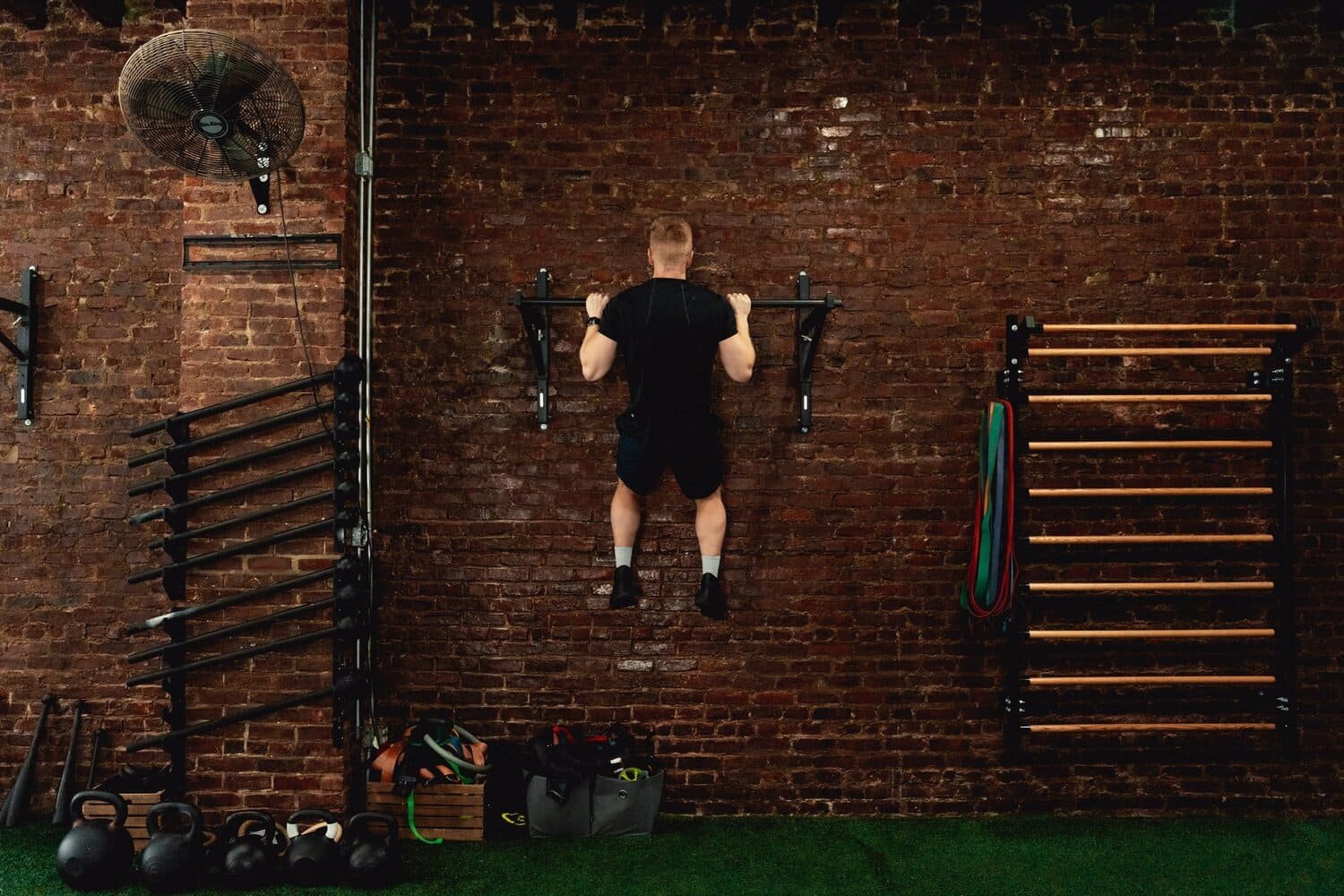
Pull-ups are one of the most valuable movements a swimmer can develop. They build not just arm strength, but total upper-body control, scapular stability, and the ability to move your body through space. When that improves, your pulling mechanics in the water usually follow.
Whether you’re trying to do 1 pull up or many, improving this pattern improves your swimming, and these progressions will get you there
Rows and overhead presses don’t mimic the stroke, but they reinforce the positions your shoulders need to stay strong and stable over thousands of strokes.

On the lower-body side, squats and deadlifts do more for your starts and turns than any “kick simulation” exercise. Stronger hips and legs mean more force off the blocks and walls—and that’s free speed.
And then there’s the core. Not just for appearance, but for connection. Rotational strength and stability under movement allow your body to transfer force effectively. That’s the difference between spinning your wheels and actually moving forward in the water.
A Practical Gym Workout for Swimmers
When I build a swimming gym workout, I keep it simple and repeatable. You start with a short warm-up to open up the shoulders, hips, and thoracic spine. Nothing complicated—just enough to get you moving well before adding load.
From there, the focus shifts to a few key patterns: pulling, hinging, squatting, and stabilizing. Each movement has a role, and together they build the strength system behind your stroke. The goal isn’t to leave the gym exhausted—it’s to leave having trained patterns that carry directly into the water.
Gym Workout Plan for Swimmers (Full Routine)
Here’s a structured example you can follow:
Main Workout (45–50 Minutes)
| Exercise | Sets | Reps | Focus |
|---|---|---|---|
| Pull-Ups | 4 | 6–10 | Build pulling strength and upper-body control |
| Barbell Deadlifts | 4 | 5 | Develop explosive hip and posterior chain power |
| Split Stance Dumbbell Rows | 3 | 8–10/side | Improve unilateral strength and core stability |
| Squats | 4 | 6–8 | Build lower-body power for starts and turns |
| Medicine Ball Rotational Slams | 3 | 10/side | Train rotational power and force transfer |
| Plank with Shoulder Taps | 3 | 20 taps | Reinforce core stability under movement |
The goal here isn’t just to complete the workout—it’s to move well under load.
Whether you’re trying to do 1 pull up or many, improving this pattern improves your swimming, and these progressions will get you there
If your technique breaks down, you’re no longer building useful strength. Stay controlled, use full range of motion, and focus on positions that carry over into the water.
Cooldown (10 Minutes)
Finish the session by bringing your body back to a neutral state.
Focus on releasing the areas that take the most load—lats, shoulders, hips, and quads—then restore length through the hip flexors, hamstrings, and chest.
This is one of the simplest ways to protect your stroke mechanics long term.
How to Structure a Weekly Gym Routine for Swimmers
How you fit strength training into your week matters just as much as what you do in the gym.
During the season, two sessions per week is usually enough. At that point, the goal is to maintain strength while staying fresh for the water. Full-body sessions work best here.
In the off-season, you can increase to three sessions per week and push a bit harder. This is where you build the strength base that carries into race season.
If you want a deeper breakdown, read the full guide here:
How Often Should Swimmers Lift Weights
Where Most Swimmers Get It Wrong
This is where progress usually stalls.
I’ve watched swimmers spend entire sessions doing banded “swim strokes” that look specific but don’t build real strength. Others rely too heavily on machines, isolating muscles instead of training the body as a system.
And then there’s mobility. If you’re building strength on top of restriction, you’re setting yourself up for shoulder issues and technical breakdowns.
Strength training should support your stroke—not slowly work against it.
Swimming and Gym Training Work Together
This isn’t an either-or situation. Swimming develops feel for the water, endurance, and technique. The gym builds the strength and durability that allow you to execute that technique under pressure. When those two are aligned, progress becomes much more predictable.

Build Strength That Shows Up in the Water
Over the years, I’ve coached swimmers who train hard but stay stuck—and others who make steady, measurable progress. The difference usually comes down to how they approach the fundamentals. Strength training doesn’t need to be complicated. It needs to be intentional. Focus on movements that build real capacity, stay consistent, and protect your mobility as you get stronger.
That’s how you build a body that actually performs in the water.
Take the Next Step
If you’re serious about getting stronger in a way that actually shows up in the water, you need more than random workouts—you need structure.
My Dryland Programs for Swimmers are built to give you exactly that. Each month, you’ll follow a clear plan focused on strength, mobility, and power—designed specifically for swimmers, not general fitness. You’ll know what to do, how to progress, and how to connect your gym work directly to your performance in the pool.
Start your monthly dryland subscription and train with purpose.
-
Most swimmers benefit from two sessions per week during the season and up to three in the off-season, depending on recovery and training load.
-
Compound movements like pull-ups, squats, deadlifts, and rows provide the most consistent carryover to swimming performance.
-
Only if programmed incorrectly. Poor structure, excessive fatigue, or reduced mobility can negatively impact performance.
-
Yes—with proper technique and control. Strength is essential for power, but it has to be usable in the water.
-
A general gym routine focuses on muscle development, while a swimmer-specific program targets performance, coordination, and movement quality.
-
Swimming builds endurance and technique, but strength training develops the power and stability needed to maximize both.