

Freestyle Flip Turn Technique: How to Turn Faster Without Losing Speed
/I’ve coached swimmers for more than two decades, and if there’s one skill that quietly separates good swimmers from fast swimmers, it’s the flip turn.
Not the stroke.
Not the start.
The turn.
Most swimmers treat the wall like a pause button. The fastest swimmers treat it like a launch pad. If your freestyle flip turn technique is rushed, loose, or inconsistent, you’re giving away free speed every single length — no matter how good your swimming looks between the walls.
This guide breaks down how to do a flip turn in freestyle step by step. No gimmicks. No overcomplication. Just the fundamentals that actually transfer to faster swimming.
Faster Freestyle in 10 Days
Swim faster with 10 short, focused workouts that improve freestyle technique, power, and faster turns.
Why Flip Turns Matter More Than You Think
A single flip turn might only cost a few tenths of a second. But multiply that by every wall in a practice, race, or season, and the time adds up fast.
More importantly, flip turns control momentum. A bad turn kills speed. A good turn preserves it and amplifies it.
I see this constantly with triathletes and masters swimmers. They swim well through the middle of the pool, then drift into the wall, flip loosely, and restart their stroke like they’re beginning a new lap. That stop-start pattern is exhausting and slow.
And yes, triathletes and open-water swimmers — I know, there are no walls in open water. But the fastest open-water swimmers still spend a lot of time training in the pool, and the best of them have excellent turns. A good flip turn sharpens your feel for the water, increases your awareness of drag, and sets you up for a cleaner, faster lap. If you want to hold a stronger pace or move into a faster lane, you’ll notice something right away: those swimmers turn well and streamline off every wall. When I review watch data for stroke count and pacing, I always assume a proper flip turn and streamline to the flags (or beyond). Poor turns distort the data — good turns make the training transferable.
A proper freestyle swimming flip turn technique should feel like one continuous movement, not a break.
What a Proper Freestyle Flip Turn Actually Is
Before drills or fixes, we need a clear definition.
A strong freestyle flip turn has four phases:
The approach – carrying speed into the wall
The rotation – a tight, controlled flip
Wall contact – clean foot placement that stores energy
Push-off and breakout – transferring power back into swimming
Every problem I see with flip turns comes from one of these phases breaking down.
Freestyle Flip Turn Rules (Quick Clarity)
In freestyle, the rules are simple:
You can turn any way you want
You do not need to touch the wall with your hands
You must surface before 15 meters
That’s it.
This means flip turns are legal for pool swimmers, triathletes, and masters athletes alike. Even if open turns are allowed, flip turns are almost always faster because they preserve momentum and body alignment.
The Approach: Speed In, Not a Glide
One of the most common mistakes is slowing down into the wall.
Swimmers subconsciously lift their head, shorten their stroke, or glide the last few feet. That hesitation kills speed before the flip even begins.
Your goal is simple: carry speed into the wall.
Keep your stroke count and rhythm
Finish your last pull with intent
Let the flip happen as a continuation of swimming
If you’re wondering where to look during the turn, this short visual helps put things in perspective:
What a Swimmer Sees During a Flip Turn
You don’t need to stare at the wall. Trust your timing and let your body do the work.
The Flip: Tight Beats Fast
Speed in the flip doesn’t come from throwing your head or rushing the motion. It comes from tightness.
A clean flip turn starts with a controlled chin tuck, compact rotation, and core engagement bringing the knees to chest in the tightest ball possible. This is where many swimmers benefit from freestyle flip turn slow motion work to feel what’s actually happening.
If you’re teaching how to flip turn freestyle swimming tips for beginners, slow the movement down first. Control always comes before speed.
Wall Contact: Where Turns Are Won or Lost
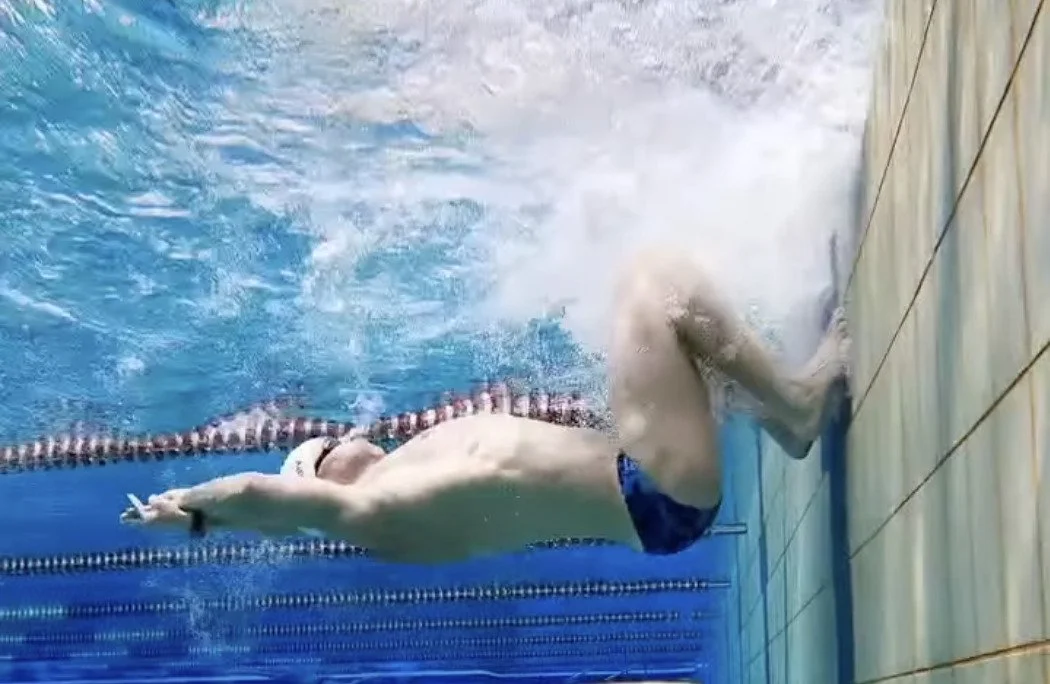
Foot placement is the difference between a powerful push-off and a wasted one.
When your feet hit the wall, you want:
Feet square, not staggered - either at 12 o’clock or a 45 degree angle
Pressure through the balls of the feet
Knees bent in a quarter squat
Arms already locked into streamline
Most swimmers hit the wall too low, too high, or with uneven feet. That forces a correction before the push-off, or leaving the wall at the wrong angle, and that delay costs speed.
This video breaks down the most common turn faults I see in real swimmers:
Freestyle Swimming Flip Turns – Dan Daly
Angle of attack, foot placement, and late arm position show up again and again — especially in group training environments where turns are rushed and never corrected.
Push-Off and Streamline: The Hidden Speed Phase
Once your feet touch the wall, the turn isn’t over. In many ways, it’s just beginning.
Your push-off should be explosive but controlled. Arms snap into a tight streamline before the feet leave the wall. The body follows the arms, not the opposite.
A few key points:
Lock the streamline immediately - like a gymnast landing a vault
Push through the hips, not just the knees
Stay long off the wall
Breathing during the flip turn is another common question. For developing swimmers, it’s okay to breathe occasionally. For faster swimmers, breathing off the wall almost always disrupts alignment and timing. Learn to delay the breath until the breakout whenever possible.
Freestyle Flip Turn Drills: A Simple Progression
You don’t need dozens of drills. You need the right ones, done with intent.
A progression I use often:
Kickboard Flip Turns
This removes stroke complexity and forces clean rotation and foot placement.
Next, add controlled freestyle into the wall at moderate speed. Then progress to race-pace entries where you maintain stroke rhythm all the way into the flip.
Focus on one element per session. Trying to fix everything at once rarely works.
Dryland Training for Better Flip Turns
Flip turns aren’t just a pool skill. They’re a strength and coordination skill.
The ability to tuck tightly, control rotation, and maintain arm position comes from core strength and body awareness. I often compare the movement to skinning the cat on rings — the body rotates around stable arms.
Here’s a progression of hanging and core drills that transfer extremely well to turns:
Core Training and Flip Turns for Swimming
You don’t need to start here as a beginner, but for swimmers chasing faster turns, dryland makes a real difference.
Power Transfer: Using VASA Training to Improve Flip Turns
A fast flip turn is about power transfer, not just rotation. You need stable arms, a tight core, and legs that can drive force into the wall without breaking alignment.
VASA trainers help reinforce this exact pattern. They teach swimmers to stay organized through the arms and core while the legs generate power — the same coordination needed for strong flip turns and explosive starts.
Improve Your Swim Starts and Flip Turns with VASA Training
This isn’t about max effort. It’s about clean, repeatable power that carries over to the pool.
You can also support turn power and timing with simple plyometric prep. Skipping is one of my go-to warm-up tools for swimmers because it builds rhythm, stiffness, and lower-body coordination.
Shop VASA Swim Trainers
Learning From the Best: Bruno Fratus
Bruno Fratus is one of the best examples of aggressive, efficient turns. Having more 50m swims under :22 than any other swimmer, Bruno know how much time is one and lost at the wall.
Watch closely and you’ll notice:
No deceleration into the wall
Extremely compact rotation
Aggresive but controlled push-off
Immediate streamline with no hesitation
Elite turns aren’t fancy. They’re disciplined.
Source: GoSwim Youtube
Common Freestyle Flip Turn Mistakes (And Fixes)
If your turns feel inconsistent, check these first:
Turning too far from the wall
→ Adjust your last stroke timing, not your flip speed
Hitting the wall too close
→ Initiate rotation earlier, not harder
Loose streamline
→ Lock arms first, then push
Floating before the breakout
→ Push with intent and commit to the underwater phase
Fix one issue at a time. Mastery comes from patience.
How to Practice Flip Turns Without Overthinking
Here’s the simplest approach I know:
Set aside specific time for turns
Train at realistic speeds
Record your technique when possible
Get external feedback
Focus on one correction per session
Flip turns don’t improve by accident. They improve through attention.
Coach’s Final Takeaway
Freestyle flip turns are not a trick, a shortcut, or a natural talent some swimmers are born with. They are a skill built on fundamentals that can be learned, refined, and reinforced over time. When rotation stays tight, foot placement is consistent, the streamline is strong, and practice is intentional, speed stops leaking at the wall. The turn becomes part of the swim instead of a break from it. When that happens, freestyle feels smoother, faster, and more connected from wall to wall. Excellence lives in the fundamentals. Fix the turn, and the rest of your freestyle often improves right along with it.
About
Dan Daly is a swim coach with over 20 years of experience working with competitive swimmers, triathletes, and masters athletes. A former collegiate swimmer and CSCS-certified strength coach, Dan is known for blending evidence-based training with practical, pool-deck coaching. He is the founder of the Train Daly methodology, where the focus is on sustainable progress, technical excellence, and long-term performance built on strong fundamentals.