

Skipping Exercise for Warm-Up: Power Up Your Swim Session
/
Every swimmer I’ve coached – from first-year high school athletes to masters chasing personal bests – has heard me say the same thing: Excellence lives in the fundamentals. And when it comes to preparing your body for the water, one of the most underrated fundamentals is the skipping exercise.
Most swimmers think of skipping as something you did in elementary school gym class, not something that belongs in a pool-side dynamic warm-up. But skipping is one of the simplest ways to wake up your nervous system, turn on your hips, and build the kind of elastic, springy movement you need for fast swimming.
If you’ve ever rushed through warm-ups or jumped straight into practice “cold,” you’ve felt the difference—heavy legs, slow catch, sluggish rotation. A proper skipping routine changes that. It primes your body before the first stroke ever hits the water.
If you want a complete on-deck warm-up—not just individual drills—I’ve built an entire system for swimmers inside my Dryland Training Program. It’s the same structure I use with competitive athletes every week.
Start your free 7-day trial
Why Skipping Is a Good Exercise for Swimmers
I’ve seen swimmers lower injury rates, sharpen coordination, and improve sprint power simply by adding 2–3 minutes of skipping into their warm-up. Here’s why it works:
1. Skipping Builds Elastic Power
Swimming isn’t just about endurance. Your hips, ankles, and feet need the same elastic recoil you’d use during skipping.
That responsiveness helps with starts, turns, and leg-driven propulsion.
2. Skipping Improves Coordination
Skipping forces the upper and lower body to sync – a huge advantage in freestyle and backstroke rhythm, or in maintaining a smooth tempo at race pace.
3. Skipping Elevates Heart Rate Safely
Instead of shocking your system with sprints in the first 5 minutes, skipping ramps up intensity gradually and predictably.
4. Skipping Activates Hip Flexors and Glutes
Your kick depends on these muscles. Skipping turns them on fast.
5. Skipping Is Low-Equipment and Beginner-Friendly
No rope required. No space needed. Just movement.
If you’ve ever wondered “is skipping a good exercise?” or “what is skipping exercise?”—for swimmers, the answer is a very strong yes.
Skipping Exercise Benefits for Swimmers
Here’s what swimmers specifically gain from adding skipping to their routine:
Faster reaction time off starts
Better wall push-offs due to increased stiffness through the ankle
Cleaner catch transitions because the upper and lower body are already coordinated
Faster, more explosive muscle contractions
More efficient and sustained power endurance
Skipping is more than “warming up.” It’s preparing your entire system to move like a swimmer—long, stable, and ready to produce force.
Warm-Up Foundation: Build It Right
If you want to see how skipping drills fit into a complete land-based routine, I break it down step-by-step in my guide on dynamic mobility before lifting weights. It’s the same system I use with swimmers to warm up safely and build better movement patterns on deck.
How to Do Skipping Exercise Correctly
I always tell swimmers: Don’t force height. Aim for light, quick, rhythmic movement.
Here’s the breakdown:
Stay tall with relaxed shoulders
Lift one knee as the opposite arm drives upHop off the balls of your feet
Keep contacts short and light
Use this as your dynamic warm-up before hitting the pool or even before dryland.
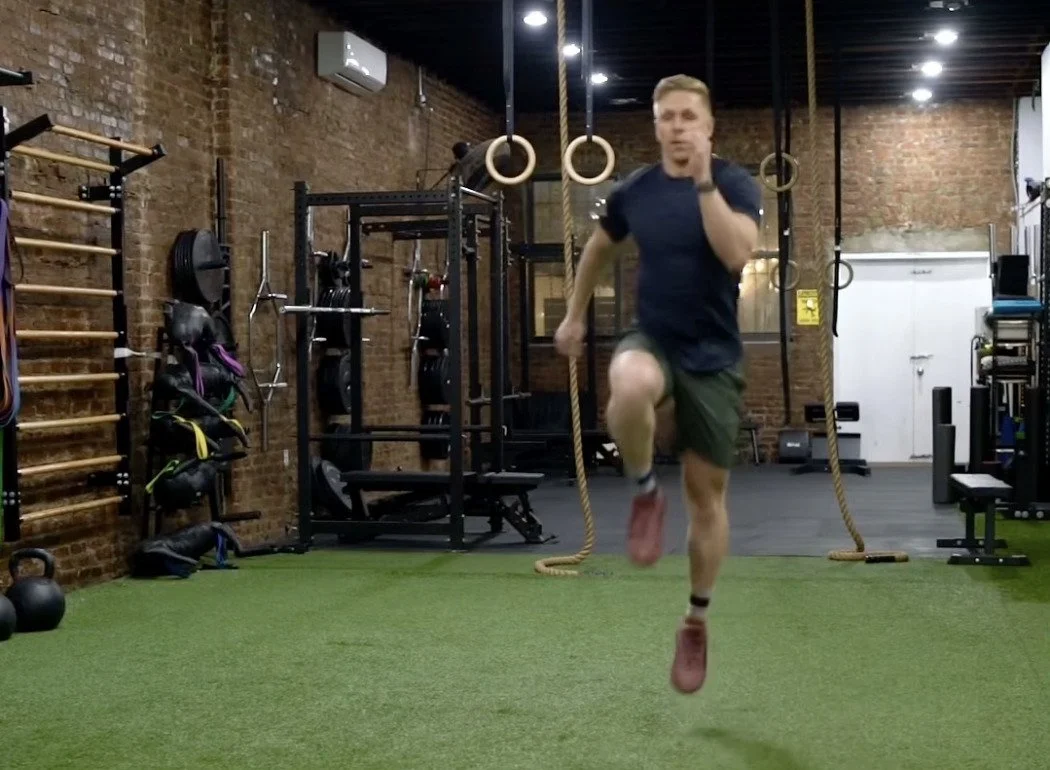
Watch: Skipping Dynamic Warm-Up exercise. Moving or in place, alternate legs and skip, hopping off one foot while lifting and flexing the opposite hip, and driving the opposite arm overhead. Stay light, tall, and quick off the floor.
Skipping Variations for a Complete Swimmer Warm-Up
This is where the routine gets fun. I use several progression-based movements that help swimmers build rhythm, balance, and hip function.
1. Power Skipping
Want to increase force? Add height and hip drive.
Good for: Sprinters building explosiveness.
2. Skippioca (Carioca + Skip)
This one fires the hips, pelvis, and core rotation—perfect for freestyle and backstroke timing.
🎥 Watch: Skippioca Dynamic Warm-Up
Complementary Warm-Up Movements for Swimmers
Skipping is the anchor, but a full dynamic warm-up includes more. Here are the supporting movements I use in almost every session.
Single-Leg Walkout
This challenges balance, core control, and shoulder stability—three things swimmers often miss.
Dan Daly demonstrates a stability-focused walkout that tests balance, core control, and shoulder stability—common weak points for swimmers. Stand on one leg, hinge forward to the floor, walk out to a high plank, then return to standing without losing alignment.
Hopping Dynamic Warm-Up
This reinforces ankle stiffness and reactive strength—key for better starts and push-offs.
Dan Daly demonstrates a quick reactive warm-up drill - Hopping
Bounding (Plyometric)
Soft, rhythmic double-leg hops performed for distance. Focus on short ground contact time and smooth transitions from one jump to the next. Bounding teaches forward momentum, powerful hip extension, and the kind of elastic strength swimmers rely on during starts, underwater dolphin kicks and turns.
Dan Daly demonstrates rhythmic double-leg bounding to train forward momentum, hip power, and the elastic strength swimmers need for explosive starts
Shuffle Dynamic Warm-Up
Fantastic for lateral motion and hip control—especially helpful for breaststroke kicking and knee health.
Lateral Pogos
One of my go-to drills for building lower-body elasticity and tendon strength. Keep your legs long and hop side-to-side with quick, light contacts off the floor. This improves the reactive qualities you need for faster starts, turns, and streamlined kicking.
Dan Daly shows fast side-to-side hops that build elasticity and tendon strength for quicker starts, smoother turns, and cleaner streamlined kicking.
Carioca
Great for rotation, rhythm, and whole-body athleticism.
Knee Hugs & Progressions
Perfect for activating the glutes and improving hip mobility.
Dynamic Quad Stretch
Helps loosen tense quads before kicking drills or sprint sets.
Skipping Exercise Routine for Swimmers (2–4 Minutes)
Here’s the warm-up I use on deck before practice. It builds rhythm, elasticity, and coordination without overwhelming your system. Each drill flows into the next, preparing your body for efficient, powerful swimming. This routine takes only a few minutes, but it sets the tone for a stronger, smoother swim session.
20 seconds Skipping
Light, rhythmic movement to wake up coordination.20 seconds Carioca
Add rotation and loosen up the hips.20 seconds Shuffle
Activate lateral hips and footwork.20 seconds Power Skipping
Increase force and hip drive.20 seconds Lateral Pogos
Quick, side-to-side hops to build ankle stiffness and tendon strength.20 seconds Bounding
Forward plyometric hops for hip extension and reactive power.10 Single-Leg Walkouts (each leg)
Balance + core + shoulder stability.20 seconds Hopping
Fast, elastic contacts to finish priming the lower legs.20 seconds Skippioca
Coordination and rhythm to tie the entire series together.
Skipping Exercise for Beginners
If you haven’t skipped in years, don’t worry—you’re not alone. I see this all the time with swimmers who are used to linear, low-impact movement in the water. Skipping feels unfamiliar at first, but it becomes comfortable quickly when you ease into it.
Begin with 10 seconds of marching knee lifts to reinforce balance and posture. Move on to 10 seconds of light skipping, staying low and rhythmic.Follow that with 10 seconds of skipping again, this time letting your arms swing naturally. Add 10 seconds of gentle lateral steps to loosen your hips, and finish with 10–15 seconds of relaxed skipping to tie everything together. It’s short, simple, and helps your body settle into a natural pattern before you progress to more dynamic movements.
Skipping Progression: Week 1–4
I always tell swimmers: build the skill before you build the power. Here’s a simple four-week progression you can follow:
| Week | Focus | Routine Details | Coaching Notes |
|---|---|---|---|
| Week 1 | Find Your Rhythm | 3 × 15–20 sec marching knee lifts | The opposite arm and leg move together naturally. Keep posture long. |
| Week 2 | Add Coordination | 3 × 10–15 sec light skipping | Stay tall, relaxed, and close to the ground. Rhythm first, power later. |
| Week 3 | Add Athleticism | 3 × 10 sec lateral pogos | Light, quick contacts. Don’t force height—think “elastic, not heavy.” |
| Week 4 | Add Power | 3 × 10 sec power skipping or bounding | Drive the hips. Short ground contact time. Smooth, reactive movement. |
Who Should Use Skipping as a Warm-Up?
I use it with:
Age-group swimmers
High-school sprint teams
Collegiate distance groups
Masters swimmers needing joint-friendly warm-ups
Triathletes prepping for open water
Everyone benefits because skipping trains movements swimmers rarely practice on their own: elasticity, rhythm, and athleticism.
Final Takeaway
Skipping isn’t just “extra movement” before getting in the water—it’s one of the most powerful warm-up tools a swimmer can use. Done right, it improves coordination, activates key muscles, and primes your whole system for fast, efficient swimming.
If you’re looking for an easy way to make the first 10 minutes of practice count, start with skipping. A better warm-up leads to a better swim session—every time.
Want more dryland warm-ups built specifically for swimmers?
Try my full Dryland Training Program for Swimmers – free for 7 days