

Pull Buoy Swimming: How to Use It Correctly and Why It Matters
/In pull buoy swimming, some swimmers notice they’re faster with a buoy than without one. I’ve coached swimmers for years who swear this is true—and most of the time, they’re right.
But here’s the part most swimmers miss: the pull buoy isn’t making you faster — it’s revealing something about your technique.
When used correctly, a pull buoy is one of the most effective teaching tools in swimming. When used mindlessly, it becomes a crutch that hides problems you still need to fix. The difference comes down to intent.
In this guide, we’ll break down what a pull buoy is used for in swimming, why some swimmers go faster with it, and how to use a pull buoy correctly so it improves your freestyle—not just your training ego.
Ready to train smarter, not harder? Use DALY25 at checkout and get 25% off select FINIS swimming gear.
This includes kickboards, dryland tools, and key training essentials I use every week with competitive swimmers.
What Is a Pull Buoy in Swimming?
A pull buoy is a piece of swimming equipment placed between the thighs or ankles to provide buoyancy to the lower body. Its primary role is to lift the hips and legs, reduce drag, and temporarily remove the kick from the equation so swimmers can focus on alignment and upper-body mechanics.
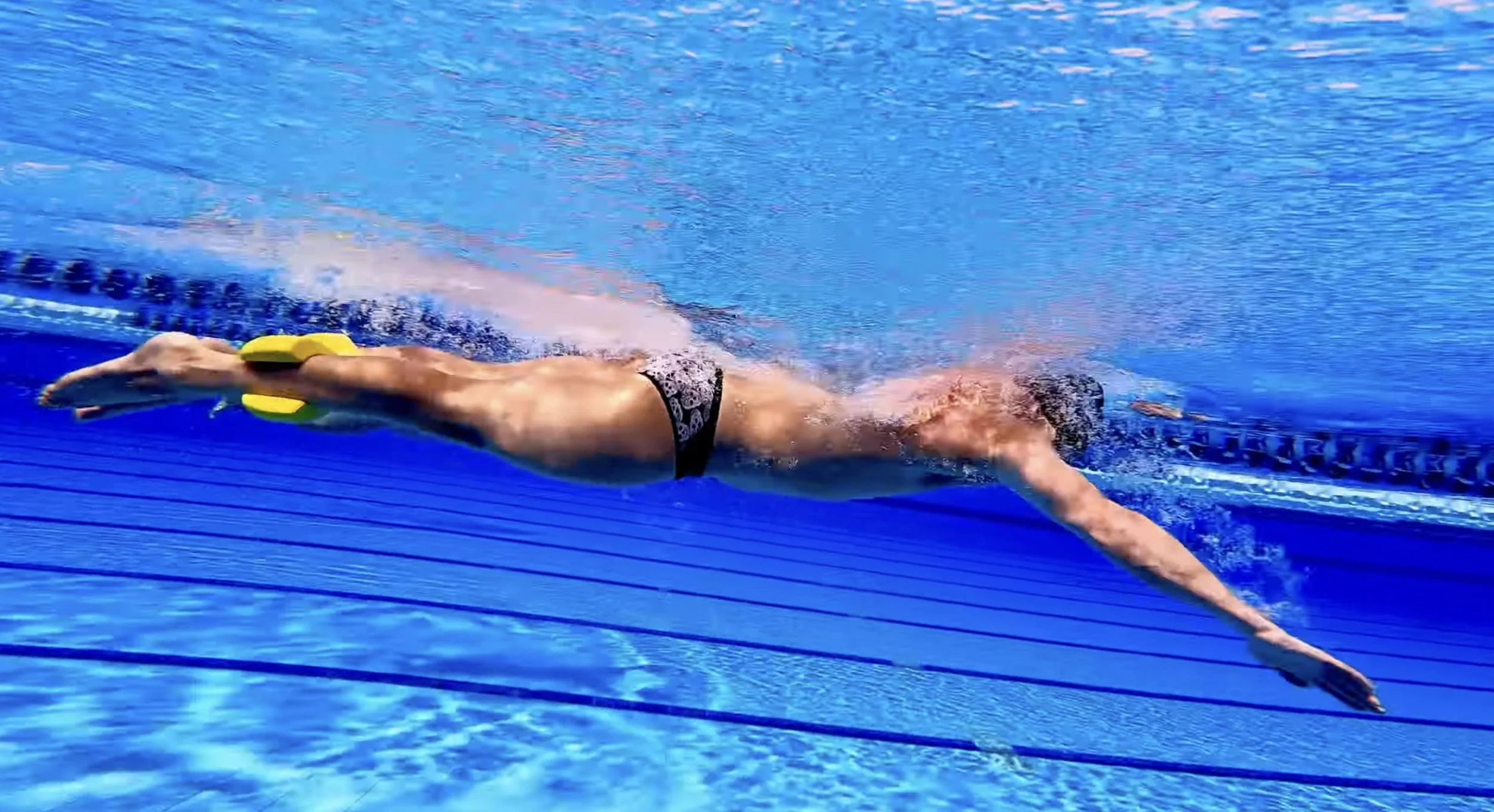
In practical terms, a pull buoy:
Supports the lower body so the hips stay high
Shifts propulsion demands to the arms and upper body
Minimizes or removes the kick
Because of this, pull buoys are most often used in freestyle pull sets, technique-focused sessions, recovery swims, and upper-body conditioning. Understanding what the buoy is doing for you matters far more than simply knowing how to put one on.
Why Some Swimmers Swim Faster With a Pull Buoy
If you’ve ever noticed your pace improve the moment you add a pull buoy — and then drop as soon as you remove it — you’re not alone. This pattern shows up in swimmers at every level.
A great real-world example is Katie Ledecky. Her freestyle is what we’d call front-quadrant or upper-body–dominant. She maintains a high arm cadence, roughly around 90 strokes per minute, while keeping her kick relatively quiet for most of her races.
From an energy standpoint, this matters. When body position and technique are solid, using the smaller muscles of the upper body can be more oxygen-efficient than relying heavily on the large muscle groups of the legs. Katie pairs that efficiency with excellent alignment, strong hip-driven rotation, and a connected core that allows her upper body to generate propulsion without excess drag.
When most swimmers add a pull buoy, something similar happens — at least on the surface. The buoy lifts the hips, reduces drag, and makes the stroke feel smoother almost instantly. As a result, pace often improves right away.
But that improvement doesn’t automatically mean the buoy is helping your swimming long-term.
In many cases, it’s compensating for issues that show up the moment the legs are reintroduced. Dropping hips, inefficient kick timing, poor core engagement, low stroke tempo, or unstable rotation can all disappear temporarily when a buoy is holding your body in position. In other words, the swimming pull buoy isn’t fixing the problem — you’re borrowing alignment from the equipment.
Why Some Swimmers Swim Faster With a Pull Buoy
If you consistently swim faster with a pull buoy, that’s useful information. It’s a cue to examine your body position without the buoy and your kick technique and tempo.. The goal is to understand why the buoy helps you — then train so you can hold that same alignment on your own.
Ultimately, you should be faster without a pull buoy.
If you’re slower with a buoy, the issue is often the opposite. Low arm turnover can limit the benefit of pull work. In those cases, increasing stroke cadence helps unlock what the buoy is designed to teach.
What Swimming With a Pull Buoy Teaches You
Used intentionally, swimming with a pull buoy teaches three critical skills.
First, it improves body position awareness. By lifting the hips and legs, the buoy places you in a more downhill position and allows you to feel what proper alignment should feel like. If your stroke falls apart when the buoy comes out, that feedback is valuable — not a failure.
Second, it reinforces core engagement. A gentle squeeze of the buoy activates the inner thighs and connects directly into the core, helping you maintain a long, taut body line instead of hinging at the hips. This is especially helpful for swimmers who over-kick or lose alignment during breathing.
Third, it isolates upper-body propulsion. With the kick removed, forward motion must come from catch quality, pull path, and rotation timing. You quickly learn whether your arms are actually producing propulsion or just moving water. Pull buoys also reduce glide time, encouraging a higher stroke tempo. Many swimmers have a fixed or limited range and strategy with stroke tempo or rate. Because it’s also more energy and oxygen efficient, swimmers may find they can keep their head down, and breathe less.
Freestyle Pull Buoy and Paddles: When and Why to Combine Them
Swimming with a pull buoy and paddles is one of the most effective ways to isolate the upper body while maintaining a strong, streamlined position.
The buoy lifts the legs and reduces drag, lowering oxygen demand from the kick and allowing swimmers to ride higher in the water. This is why swimmers with weaker or inefficient kicks often feel immediately faster when pulling.
At the same time, gently squeezing the buoy helps maintain a long, connected body line. This setup is also useful for shorter-axis strokes like breaststroke and butterfly, where posture and control matter more than kick power.
Best Pull Buoy For Swimming
Paddle choice matters. Beginner to intermediate swimmers should stick with small to medium paddles. Oversized paddles slow stroke rate and overload the shoulders. Remember: force and speed have an inverse relationship. Large paddles improve distance per stroke, but often at the expense of tempo.
I prefer strapless paddles because they demand cleaner entry and a more effective catch to stay in place.
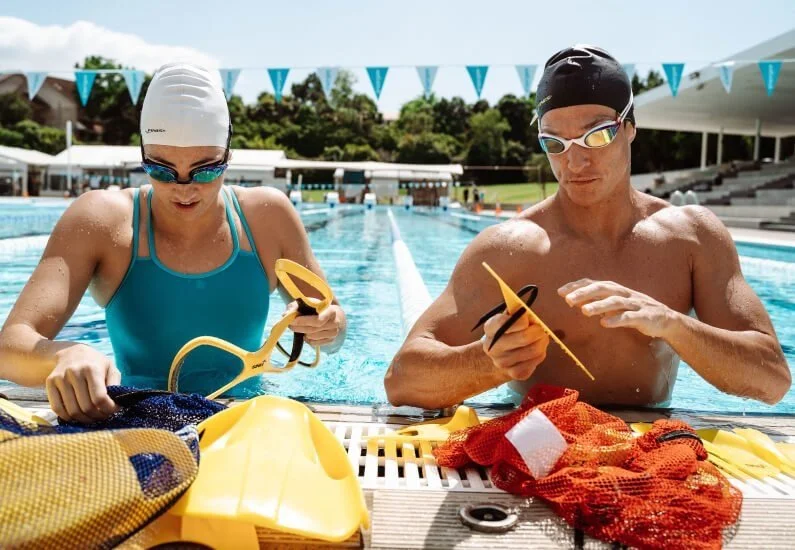
Recommended equipment used here:
Get 25% off all FINIS products with code DALY25: Shop FINIS
Long Axis Buoy Placement: A Step Up in Difficulty
Traditional pull buoys are place above the knees, which provides greater lift to the hips and reduces oxygen demand from the legs. This setup works well for traditional pull sets
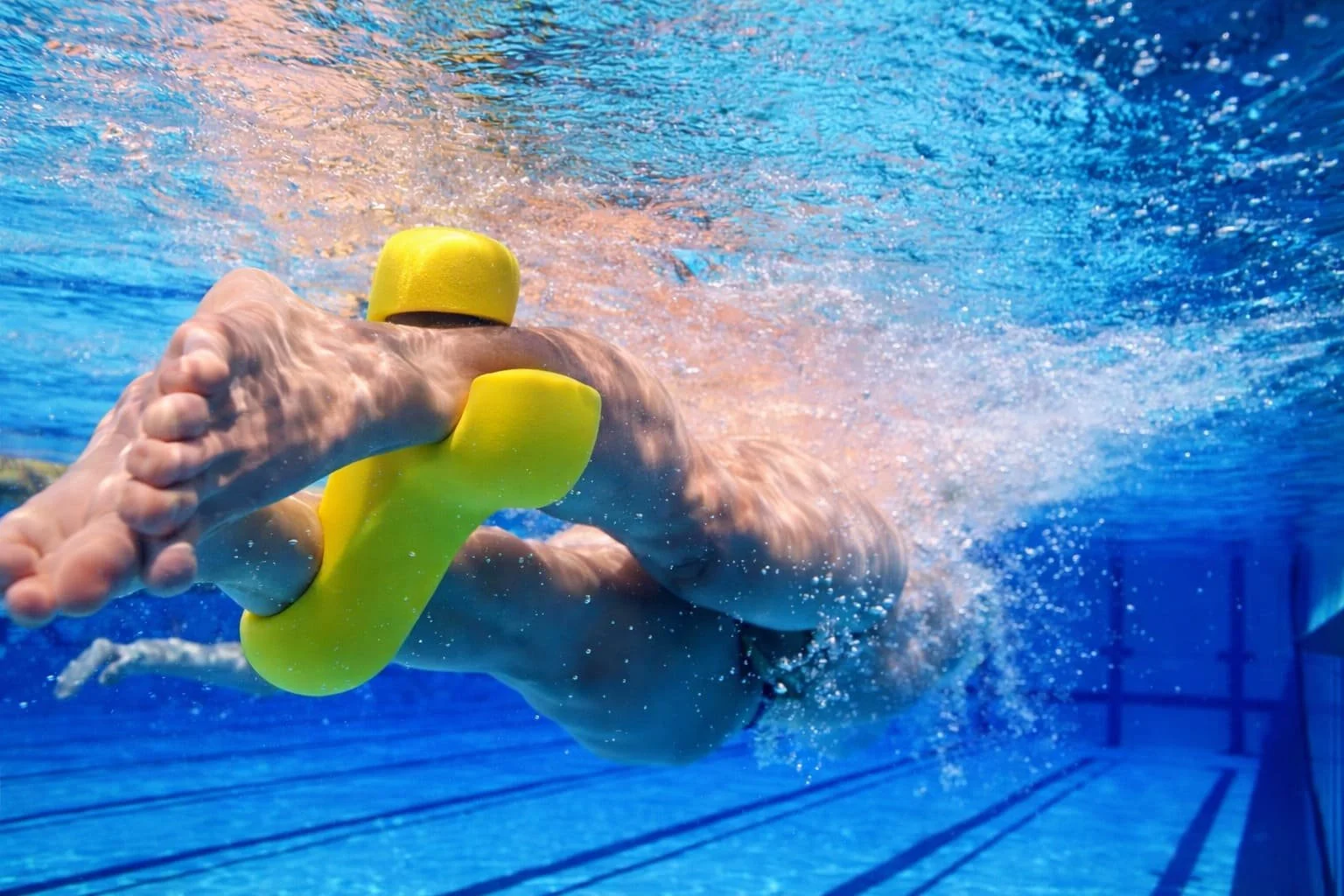
However, using a long-axis buoy, like the Finis Axis Buoy, at the ankles changes the challenge completely.
When worn lower on the legs, the buoy creates a longer lever and demands stronger core stability, symmetrical rotation, and active control of head and chest pressure. There’s far less margin for error, which makes this setup extremely effective for freestyle and backstroke body-position work.
Finis Long Axis Buoy > Freestyle Swimming > Coach Dan Daly
When Pull Buoy Swimming Becomes a Problem
Here’s the uncomfortable truth: you should ultimately be faster without a pull buoy.
If you’re not, something is missing in your full-stroke swimming. In many cases, the buoy is masking underlying issues such as poor kick fitness or timing, over-reliance on leg buoyancy, or weak core control and inconsistent rotation.
If you notice that you actually swim slower with a pull buoy, the issue is often the opposite. Low arm turnover can limit the benefit of pull work. In that case, increasing stroke rate allows you to take advantage of pull buoy training without losing rhythm or connection.
Train the Fundamentals the Right Way
If pull buoy swimming exposes gaps in your technique, structured training makes the difference. Our swim programs are designed to fix the fundamentals first—body position, rotation, and propulsion—so tools like the pull buoy actually transfer to faster swimming.
Final Coach’s Takeaway
If you swim faster with a pull buoy, don’t celebrate too quickly. Ask why.
Is it lifting your hips?
Cleaning up your alignment?
Reducing the oxygen cost of your kick?
Those answers tell you exactly what to work on next.
Used correctly, a pull buoy teaches you how speed is created. Used carelessly, it delays progress. Excellence lives in the fundamentals—and that includes how you use your tools.
Want Expert Eyes on Your Technique?
If you’re ready to stop guessing and start fixing the real issues behind your pull buoy performance, personalized coaching makes the process faster and clearer.
Should you train with fins or drag socks? While both are valuable swimming tools, they develop different qualities. Drag socks build kick-specific strength and improve force production, while fins enhance rhythm, body position, and speed. In this guide, Coach Dan Daly explains how combining resistance and assisted training creates a more powerful, efficient kick that transfers directly into racing. Learn when to use each tool, common mistakes to avoid, and how to structure kick sets for maximum performance.