

Stability Ball Exercises for Swimmers: Build Core Strength, Balance, and Control
/very swimmer wants more power in the water – but the secret isn’t always more yards. Some of the biggest improvements I’ve seen over the past 20 years didn’t come from extra laps; they came from better control. And that’s exactly where the stability ball shines.
When you train on an unstable surface, you force your deep core, hips, and shoulders to work together. That interconnection is the foundation of strong swimming. If you want a tighter streamline, a more powerful kick, or better rotation, stability ball exercises are an effective tool you can use on land.
In this guide, I’ll walk you through the best stability ball exercises for swimmers, why they matter, and how to use them in your weekly dryland routine.
Why Swimmers Should Train With a Stability Ball
I’ve coached thousands of swimmers – from age-group to Olympic-trial level – and the strongest athletes I’ve worked with share one thing: they’ve built stability before they chase intensity. The stability ball helps you do exactly that. There’s a saying in strength and conditioning, “You can’t shoot a cannon out of a canoe.” If your core cannot help you maintain a long taut streamline, it doesn't matter how strong and powerful your pulls and kicks are.
Here’s why it belongs in your dryland routine:
It strengthens the deep core needed for maintaining streamline off your starts, turns, and transferring force between your shoulders and hips.
It challenges balance and body awareness – essential for all four strokes
It also enhances stability and force production in the gym and other sports.
Think of it as controlled instability – the perfect way to teach your body to connect hips, spine, and shoulders the same way you need in the water.
Stability Ball Exercises for Swimmers
The 4 Stability Ball Exercises Every Swimmer Should Master
Below are the exact exercises I program for swimmers who want stronger core control, better streamline, and powerful propulsion. These movements target every part of your midline.
1. Stability Ball Knee Tucks
This exercise teaches swimmers how to connect the hips and core while maintaining a long spine. It’s one of the best ways to improve kick efficiency and turns.
How to do it:
Start in a plank with your feet on the ball. Pull your knees toward your chest while keeping your hips level. Don’t let your lower back sag or your knees drop to the floor. Imagine your are tucking tight for a turn.
Coaching cues:
Press through the floor
Think “ribs down connected to pelvis”
Draw your knees into your chest and tuck tight
Why it matters:
Great for tuns.
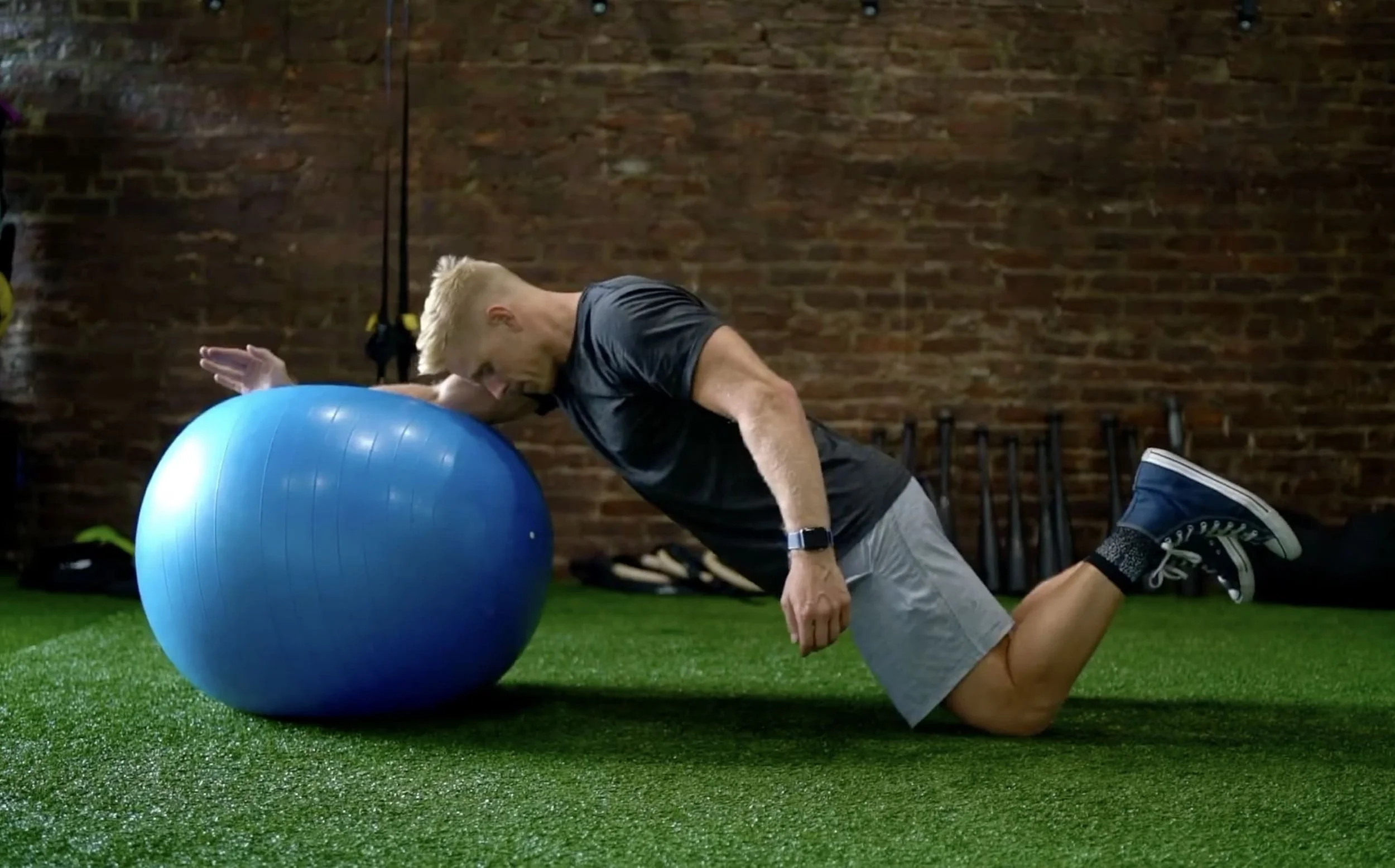
2. Stability Ball Rollouts (4×10)
Few exercises teach bracing better than rollouts. You’re training your body to resist extension while producing force overhead – just like holding a tight streamline during your catch.
How to do it:
Kneel behind the ball, place your pinkies on top of the ball at an arms reach. Lean into the movement, establishing a plank position with a straight spine and straight hips, like a push up from your knees. Hinge and rock on your knees, as you reach overhead with a neutral spine, only moving at the shoulder joint.
Common mistakes:
Overarching the lower back
Flexing and bending at the hips/waist
3. Stability Ball Glute Bridge Hamstring Curl
A powerful kick doesn’t come from your lower back – it comes from your glutes and hamstrings working as a unit. This Stability Ball Glute Bridge Hamstring Curl teaches that connection. It’s one of my go-to exercises for swimmers who need more propulsion, particularly the lift phase of the kick, without losing body alignment. This
Stability Ball Glute Bridge Hamstring Curl
How to do it:
Lie on your back with your heels on the ball. Drive your hips up into a bridge, then slowly curl the ball toward your glutes by bending your knees. Extend your legs back out while keeping your hips lifted the entire time. Lower your hips, then repeat.
Coaching cues:
Keep ribs down and hips tall
Push your arms into the floor
Why swimmers need this:
Builds the posterior chain strength behind a fast kick
Reduces lower-back overload by teaching your hips to do the work
Improves body-line stability for better streamline and rotation
Once this feels easy, progress to single-leg variations.
Swiss Ball Single-Leg Glute Ham Raise
4. Stability Ball Plank Rollouts
If there’s one exercise swimmers underestimate, it’s this one. Plank rollouts teach total-body tension – the same tension that keeps your body aligned from entry to exit.
How to do it:
Start in a plank with your forearms on the ball. Gently roll the ball forward a few inches without collapsing your lower back.
Coaching cues:
Stability Ball Plank Rollouts
Additional Stability Ball Core Exercises for Swimmers
Once you’ve built a foundation with the main four stability ball movements, these progressions help swimmers develop deeper core control, stronger shoulders, and better body alignment. Each exercise challenges your stability in a way that translates directly to faster, more efficient swimming.
Quadruped Stability Ball Rollout
A great movement for swimmers who need to improve rib–hip control without stressing the lower back. Rolling out from a hands-and-knees position teaches you how to brace through your midline while the arms move — similar to the early phases of your pull.
Great for: core connection, total body tension
Stability Ball Stir the Pot
A staple in the dryland world. Starting in a plank on the ball, you draw small circles with your forearms. This forces the shoulders, lats, and core to stabilize at the same time — the same coordination you need during catch and rotation.
Great for: shoulder stability, body-line tension, long-distance efficiency.
Swiss Ball Pike (Shoulder and Core Stability for Swimmers)
This is an advanced movement that blends shoulder strength with deep core activation. Pulling your hips into a pike position on the ball reinforces the same tension you need during underwater dolphins and overhead position
Great for: overhead position, streamline control, and high-level core stiffness.
How to Build a Stability Ball Workout for Swimmers
Whenever I build a stability ball routine for swimmers, my goal is simple: reinforce the same body positions and tension you need in the water. You don’t need a long session — just consistent, high-quality reps that challenge your core, hips, and shoulders to work together.
Below is a balanced 15–20 minute session I use with swimmers at every level.
Stability Ball Dryland Session (15–20 minutes)
1. Stability Ball Knee Tucks – 4×15
Light up the anterior core and teach controlled hip flexion — essential for stronger kicking and underwater work.
2. Stability Ball Rollouts – 4×10
Reinforce anti-extension strength and streamline stability. Move slow; tension matters more than range.
3. Stability Ball Glute Bridge or Hamstring Curl – 4×15
Build the posterior chain behind a powerful kick while improving core alignment.
4. Stability Ball Plank Rollouts – 4×8
Total-body tension. This is your connection point between land training and in-water posture.
Optional Add-On Exercises
If you have a little more time — or you’re looking to progress your routine — these stability ball drills give swimmers an extra layer of core challenge. They’re not required, but they’re excellent additions once you’ve mastered the basics.
Stability Ball Pike – 3×6–10
Quadruped Stability Ball Rollout – 3×10–12
Stability Ball Stir the Pot – 3×20–30 seconds
Stability Ball Single-Arm Rollout – 3×6 per side
This workout hits the deep core, hips, lats, spine stabilizers, and posterior chain — the exact system swimmers rely on for a longer, stronger bodyline and more efficient stroke mechanics. Add it to your dryland two or three times a week and you’ll feel the difference next time you hit the water.
Final Takeaway
Great swimming starts with great control. The stability ball teaches your body how to stay long, strong, and stable – whether you’re holding a tight streamline, rotating through freestyle, or driving a powerful kick off the walls. These movements reinforce the exact body positions we rely on in the water.
If you commit to these stability ball exercises two or three times a week, you’ll feel the difference quickly: better posture, better rhythm, and more efficient power through every stroke.
And if you want to continue building strength the right way, I recently broke down another tool I use with swimmers: medicine ball power training.
Read more here: How to Do Medicine Ball Slams: 5 Explosive Exercises for Swimmers
If you're ready for a complete, swimmer-specific dryland plan…
Start your free 7-day trial of my Dryland Training Program: